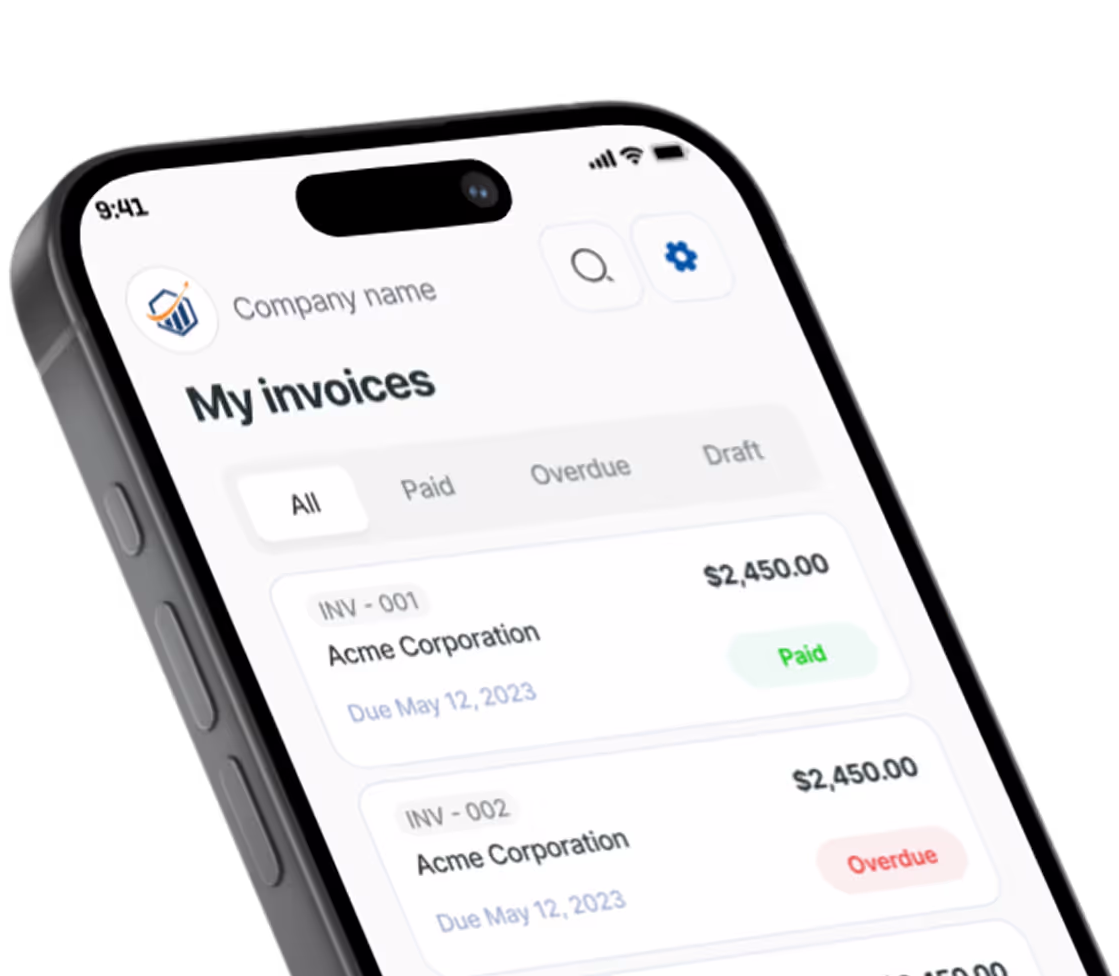
E-Check Payment: Accept Checks, No Paper
E-check payment for small business — how e-checks work, cost vs credit cards, processing times, and how to accept them from the job site.


You finished the water heater swap, packed up, and sent the invoice from the truck. The customer texts back: “Sure, I’ll cut you a check.” And now you’re looking at another trip — wait for the check to show up in the mail, drive to the bank, deposit it, hope it clears.
Paper checks are fading fast. In 2025, only 26% of business-to-business payments were made by check — an all-time low, down from 81% in 2004, according to Nacha. But customers who like paying by check aren’t going anywhere. They trust it. They’ve done it for years.
An e-check payment gives you the familiarity of a check with none of the paper. Same bank account, same routing number, no envelope, no trip to the bank. Here’s how e-checks work, what they actually cost, and how to start accepting them from your phone before you leave the driveway.
What Is an E-Check Payment?
An e-check (electronic check) is the digital version of a paper check. It pulls money from your customer’s checking account using the same details they’d write on a paper check: the routing number, the account number, and their authorization to pay. The difference is that nothing gets printed, mailed, or hand-deposited.
E-checks run on the ACH network — the same backbone that handles direct deposit and autopay. That network processed 35.2 billion payments in 2025, up 4.9% from the year before, per Nacha. So when a customer pays your invoice by e-check, the money moves through proven, everyday banking infrastructure.
One point trips up a lot of people: as Authorize.net puts it, “All eChecks are ACH transfers, but not every ACH transfer is an eCheck.” An e-check is one specific use of the ACH network — a customer paying you from their checking account. More on that distinction below.
How E-Check Payments Work: The 4-Step Process
From your side, accepting an e-check is simpler than handling a paper one. Here’s the flow.
Step 1 — Your customer authorizes the payment
Before any money moves, your customer authorizes the debit. This isn’t just good practice — it’s a Nacha requirement. The authorization has to be clear, conspicuous, and kept on file. That can be a signed form, an email reply, or a digital click-through on your invoice. Keep the record; it protects you later.
Step 2 — You collect the routing and account number
Same two numbers printed at the bottom of every paper check. Your customer enters them on your invoice or payment page, or reads them to you. Most already have these handy.
Step 3 — Your processor submits it to the ACH network
Your payment processor batches the transaction and sends it into the ACH network for clearing. You don’t touch this part — submit and move on to the next job.
Step 4 — The funds settle
Standard e-check processing takes 3 to 5 business days, per Authorize.net. If you need it faster, ask your processor about Same Day ACH — more on that below. For more ways to speed up collection, see our guide on getting paid faster with payment links.
E-Check Processing Time: Standard vs Same Day ACH
Processing time is the first question most people have about e-check payments — here’s the full picture.
Standard ACH: 3–5 business days. Two bank nights of clearing. Not instant, but predictable and reliable.
Same Day ACH: funds credited the same business day. There are now multiple processing windows each day. Submit before the cutoff (typically late morning or early afternoon — confirm with your processor) and the money moves before end of business. Same Day ACH is growing fast: 1.45 billion payments in 2025, up 16.7% year over year, according to Nacha. Most processors charge $0.50–$1.00 extra per transaction for the speed — still well below card fees.
Three questions to ask your processor before you start accepting e-checks:
- Do you support Same Day ACH?
- What is the cutoff time for same-day submission?
- Is there an extra per-transaction fee?
For field service work, where you’re finishing one job and heading to the next, Same Day ACH turns the e-check from “I’ll get paid Friday” into “I’ll get paid today.”
E-Check vs Credit Card: The Cost Math
This is where accepting e-check payments earns its keep. Credit card processing typically runs 2% to 4% of the transaction. E-check (ACH) fees are capped at 0.75% per Authorize.net, and many processors charge a flat $0.25 to $1.50 per transaction instead.
Here’s what that looks like on real invoices:
| Invoice amount | E-check fee (max) | Credit card fee (2%–4%) | You keep (vs card) |
|---|---|---|---|
| $500 | up to $3.75 | $10–$20 | ~$6–$16 more |
| $1,000 | up to $7.50 | $20–$40 | ~$13–$33 more |
| $5,000 | up to $37.50 | $100–$200 | ~$63–$163 more |
Run that across a year. If you bill 100 invoices a month at $1,000 each, using e-checks instead of cards can save you up to around $3,900 a year in processing fees. That’s money that stays in your pocket instead of going to the card networks.
It beats paper too. A business sending 100 checks a month spends $700+ monthly — over $8,400 a year — on paper-check costs (postage, supplies, staff time), while ACH at the same volume runs $300 to $1,800, per Riverview Community Bank. For a fuller breakdown, see credit card processing fees explained.
E-Check vs ACH vs Wire Transfer: What’s Actually Different
These three get lumped together constantly. Here’s the clean distinction.
E-check: Your customer authorizes a pull from their checking account using their routing and account number. Runs on ACH. Low fees, reversible within return windows, the right tool for invoice collection.
ACH bank transfer: ACH is the network; e-check is one use of it. An ACH push is when you initiate a transfer from your own account — like paying a vendor or sending payroll. Both are ACH; the direction and who initiates it are different. For the full breakdown, read our ACH bank transfer guide for small business.
Wire transfer: Bank-to-bank directly, outside the ACH network. Faster (same day to next day), but costs $15–$35 per transfer and is generally not reversible. Right for large one-time transactions where finality matters. Not the right tool for routine invoicing.
| E-check | ACH bank transfer | Wire transfer | |
|---|---|---|---|
| Who initiates | Customer (pull) | You or customer | Sender |
| Network | ACH | ACH | Fedwire / SWIFT |
| Speed | 3–5 days (or same day) | 1–3 days | Same day to 1 day |
| Typical cost | <$1.50 per transaction | Usually free | $15–$35 |
| Reversible | Yes (limited window) | Yes (limited window) | No |
For collecting on invoices, e-check wins on cost. For large, time-sensitive B2B payments where irreversibility is a feature — wire makes sense.
Can E-Checks Bounce? ACH Return Codes Explained
Yes — e-checks can bounce, same as paper checks. The difference: you find out in days via a digital return code, not weeks by getting a rubber-stamped envelope in the mail.
Common ACH return codes, per Plaid:
- R01 — insufficient funds (NSF). The most common return. Most returns have a 2-banking-day window.
- R02 — account closed.
- R03 — no account / unable to locate.
After an R01 (or R09), you can re-present the e-check up to two more times — a temporary cash gap on the customer’s end doesn’t kill the payment. Return fees run $2 to $5 from your processor.
One code to watch: R10, unauthorized. Dispute window up to 60 calendar days, and you can’t re-present it. Your defense is the authorization you collected in Step 1 — document it clearly and keep the record. Nacha enforces return-rate thresholds (15% overall, 0.5% unauthorized), so clean authorization records protect your ability to accept e-checks at all.
Compared to a paper check that bounces weeks later? You get a specific return code in days and a clear next step.
E-Check Fraud Protection: Is It Safe?
E-checks are encrypted and digitally authenticated on every transaction, and Nacha enforces the authorization requirements covered above. From your side, that is a cleaner paper trail than a physical check that can be lost, altered, or stolen out of a mailbox.
That last risk is real: 63% of organizations faced check fraud in 2024, according to the AFP Payments Fraud Survey cited by Riverview Community Bank. Taking the paper out removes a whole category of theft.
Practical fraud protection steps:
- Always get authorization before submitting — written, email, or digital click-through
- Store authorization records; you will need them if a dispute arises
- Monitor your ACH return rate; a spike in R10s signals a problem
- Use a processor with built-in bank account verification (micro-deposits or instant verification) to reduce invalid account entries
How to Accept E-Check Payments Online and in the Field
- Choose a payment processor that supports ACH/e-check. Most modern invoicing platforms connect to one.
- Get authorization in writing. Email reply, signed form, or a digital click-through on the invoice. Keep it on file.
- Enter the routing and account number into your invoicing or payment platform — or let the customer enter it themselves.
- Submit and wait for funds. Flag Same Day ACH with your processor if you need the money faster.
The field service part: all of this runs from your phone at the job site. A mobile e-check payment app that connects to your ACH processor means you send the invoice, collect authorization, and submit the payment before you pull out of the driveway — no paper, no trips to the bank, no waiting on the mail. With Pronto Invoice, you connect your own processor, so there is no markup taking a cut of every payment you collect. For more on collecting on the go, see our guide to mobile payment methods for small business.
Frequently Asked Questions
Can e-checks bounce? Yes. The most common return is R01 (insufficient funds). You get a digital return code within about 2 banking days, and you can re-present the e-check up to two more times after an R01.
How is an e-check different from an ACH transfer? All e-checks are ACH transfers, but not every ACH transfer is an e-check. An e-check is specifically a customer authorizing a debit from their checking account to pay your invoice.
How long does e-check processing take? Standard processing is 3 to 5 business days. Same Day ACH can credit funds the same business day if initiated before the midday cutoff — ask your processor whether they support it and whether there is an extra fee.
How does an e-check differ from a wire transfer? E-checks run on the ACH network and are reversible within return windows; fees are pennies per transaction. Wire transfers are direct bank-to-bank, typically irreversible, and cost $15–$35 each. For routine invoice collection, e-check wins on cost.
Can I accept e-check payments from my phone? Yes. With a mobile invoicing app that supports ACH/e-check, you send the invoice, collect authorization, and submit the payment from the job site. No paper, no bank trips.
What if a customer disputes an e-check? An unauthorized return (R10) carries a dispute window of up to 60 days. Your protection is the authorization you collected up front — document it clearly and keep the record.
Paper checks made you do the work: wait, drive, deposit, hope. An e-check payment gives your check-preferring customers the method they trust while you get paid digitally, at a fraction of card fees, without leaving the truck.
Pronto Invoice lets you accept e-checks, credit cards, and more — connect your own processor, no markup skimming your payments. Send the invoice, get paid, get back to work. For more on tightening up your collection process, see how to get customers to pay invoices faster.
There is always something more to read

10 Steps to Set Up a Small Business: The Complete Startup Checklist for 2025
Learn 10 steps to set up a small business with this checklist covering LLC, banking, invoicing, insurance, and pricing.

1099 Requirements for Small Business (2026): Complete Guide
$600 threshold is now $2,000 for 2026. Learn 1099 requirements: 1099-NEC, W-9 rules, deadlines, filing.

How to Accept Payments Online
No website needed. Here is how to start accepting online payments as a small business — processors, payment links, and invoicing in one afternoon.