Estimated Tax Payments: The 4 Deadlines
Who owes estimated tax payments, the four due dates ending Jan 15, 2027, safe-harbor rules, how to pay for free, and a set-aside plan for every paid invoice.


You get paid in full, with no tax taken out, so the IRS expects you to send in your own tax during the year. Estimated tax payments are four installments (Form 1040-ES) due April 15, June 15, September 15 and January 15 of the next year. You owe them if you expect to owe $1,000 or more after withholding and credits. Here is how to figure the number, avoid the penalty and pay for free.
Table of Contents
- Who Has to Pay Estimated Taxes?
- What Are the 4 Estimated Tax Due Dates for 2026?
- How Much Should You Pay? Start With Your Paid Invoices
- How to Avoid the Estimated Tax Payments Penalty
- How Do You Pay Estimated Taxes?
- Set Aside a Percentage of Every Paid Invoice
- What About State Estimated Taxes?
- Quick Answers
Who Has to Pay Estimated Taxes?
You have to pay estimated taxes when you expect to owe at least $1,000 for the year after subtracting withholding and refundable credits, according to the IRS estimated tax FAQ. Freelancers, contractors, side-hustlers and one-person businesses hit that line fast, because nobody withholds anything from a client’s check.
Two things catch people off guard:
- Self-employment tax counts. On top of income tax, you owe 15.3% self-employment tax (12.4% Social Security plus 2.9% Medicare), also per the IRS. Our self-employment tax breakdown shows how that number gets built.
- A good year can trigger it. Maybe you had a W-2 job last year and started taking invoices this year. If your withholding no longer covers the new income, the $1,000 rule applies to you.
If you expect to owe less than $1,000, you can skip estimated payments and settle up when you file. Not sure which side you are on? Run the numbers in the next sections and see.
What Are the 4 Estimated Tax Due Dates for 2026?
The four 2026 deadlines for calendar-year filers are April 15, June 15, September 15 and January 15, 2027, per the Form 1040-ES instructions. The periods are uneven, which is why the second payment arrives only two months after the first.
| Payment | Income earned | Due date |
|---|---|---|
| Q1 | Jan 1 – Mar 31 | April 15, 2026 |
| Q2 | Apr 1 – May 31 | June 15, 2026 |
| Q3 | Jun 1 – Aug 31 | September 15, 2026 |
| Q4 | Sep 1 – Dec 31 | January 15, 2027 |
These are the 2026 dates. Three have already passed, so if you are reading this in late October 2026, the one that matters is January 15, 2027. If you missed earlier ones, pay what you can now. A late payment is better than none, though the penalty may still apply for the late periods.
The January shortcut. You can skip the January 15, 2027 payment if you file your 2026 return and pay the full balance by February 1, 2027 (Form 1040-ES instructions). That works well if you would rather settle everything in one go.
Mark the dates in your phone calendar with a reminder one week ahead. Weekend and holiday due dates shift to the next business day, so confirm on IRS.gov when one lands on a Saturday.
How Much Should You Pay? Start With Your Paid Invoices
You can estimate your payment from what clients have already paid you, not from a forecast. Your paid invoices are your income record, and that matters when work comes in lumps. Here is the plain version of the 1040-ES worksheet:
- Total what you have been paid this year. Pull up your paid invoices and add them. Count what landed in your account, not what you billed.
- Subtract business costs. Supplies, mileage, software, insurance. Our small business tax deductions checklist and mileage tracking guide cover what usually counts.
- Project the rest of the year. Multiply the profit so far by the months left, or use your last two quarters as a guide. Lumpy income? Use the lower, safer guess for now and adjust next quarter.
- Apply the 1040-ES worksheet. It walks you from net profit to income tax and self-employment tax, and gives you a total to divide into installments.
Two methods exist for splitting the year. The regular method divides the annual number by four. The annualized income method lets you pay less in a slow quarter and more in a busy one, which suits seasonal work. The annualized method takes extra paperwork, so many people stick with equal payments.
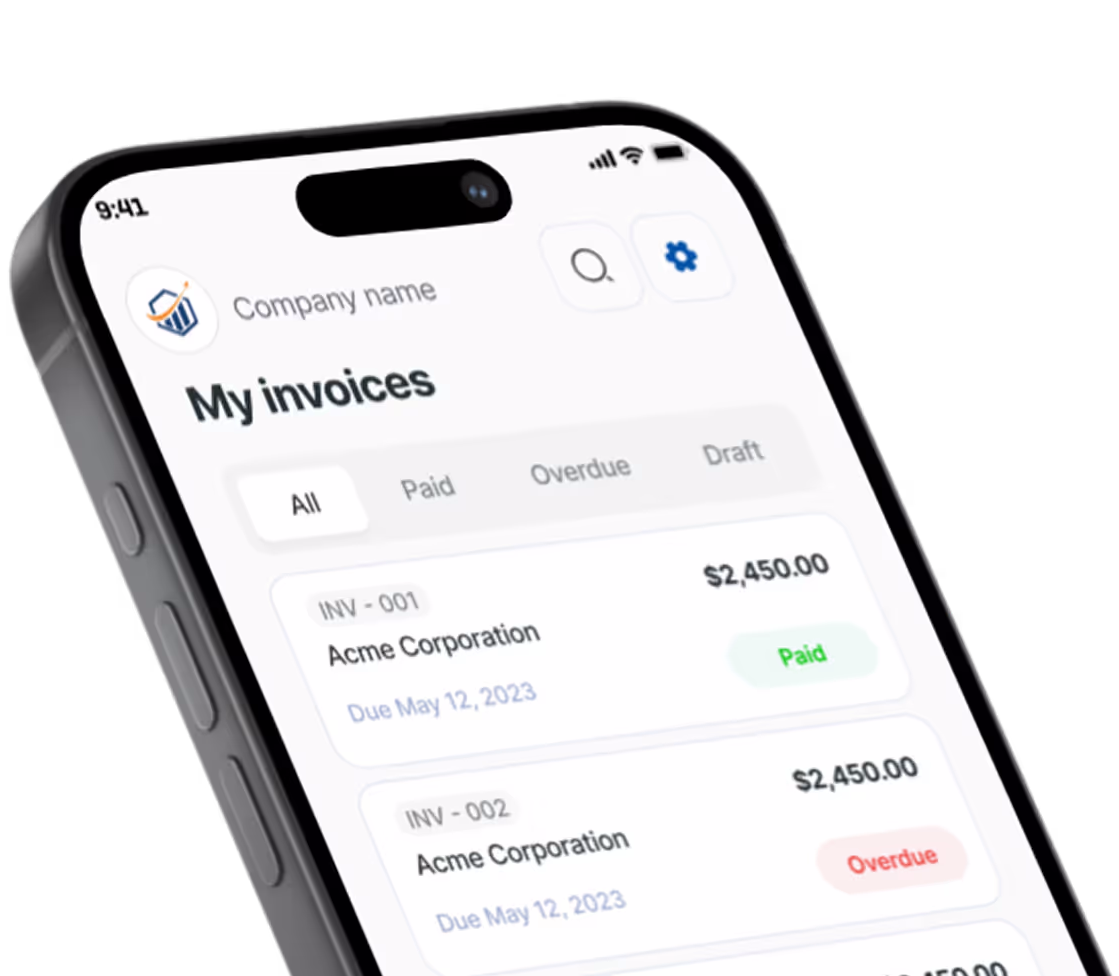
The Pronto Invoice app keeps a paid-invoice history you can open from your phone, so the year-to-date total is a quick look, not a hunt through bank statements. Mark each invoice paid when the money lands and the number is ready at every deadline.
How to Avoid the Estimated Tax Payments Penalty
You avoid the underpayment penalty by paying at least the smaller of 90% of this year’s tax or 100% of last year’s tax through withholding and timely estimates (IRS estimated tax FAQ). That is the safe harbor rule, and it removes the guesswork.
| Safe harbor | What you pay | Good when |
|---|---|---|
| 90% of this year’s tax | 90% of what you will owe for 2026 | Income dropped or is steady |
| 100% of last year’s tax | The full tax from your 2025 return | Income grew this year |
| 110% of last year’s tax | 110% of your 2025 tax | Your 2025 AGI was over $150,000 ($75,000 if married filing separately) |
The prior-year route is the one to love if your income jumps around. You know last year’s number exactly, so you can pay it in four installments and not worry about a surprise even if this year turns out huge.
A Worked Example (Hypothetical)
Say a freelancer’s 2025 tax came to $12,000. These numbers are made up for illustration, not an IRS example.
- 100% of last year: $12,000, or $3,000 per quarter.
- 110% of last year (only if 2025 AGI was over $150,000): $13,200, or $3,300 per quarter.
- 90% of this year: if the freelancer projects $20,000 in tax for 2026, 90% is $18,000, or $4,500 per quarter. Because $12,000 is smaller than $18,000, the prior-year threshold wins and the safe harbor is $3,000 per quarter.
The penalty is a real cost. Per IRS guidance (Publication 505 and the IRS penalty notice materials), it can apply even if you pay the whole balance with your return, or are due a refund, when the installments were short. Safe harbor keeps you clear no matter how the final bill turns out. You may still owe the balance in April, just without the penalty.
How Do You Pay Estimated Taxes?
You pay estimated taxes for free with IRS Direct Pay, a bank transfer that needs no enrollment (Form 1040-ES instructions). Pick the “estimated tax” payment type and the right tax year. For the January 2027 payment, set the tax year to 2026.
| Method | Cost | Good to know |
|---|---|---|
| IRS Direct Pay | Free | Bank transfer, no enrollment, instant confirmation |
| IRS Online Account | Free | Lets you see payments you made |
| EFTPS | Free | Requires enrollment first, so do it well before a deadline |
| Credit or debit card | Processor fee | Fees vary by provider, card type and amount (IRS payment options) |
| Mailed voucher | Postage | Check or money order with a 1040-ES voucher; slow and easy to lose track of |
Our pick: Direct Pay. It costs nothing, takes about two minutes on your phone, and gives you a confirmation number to screenshot. Use a card only if you need the float, and check the fee on the processor’s page before you confirm. If you also accept bank payments from clients, our ACH bank transfer guide explains how those low-cost transfers work from the other side.
Set Aside a Percentage of Every Paid Invoice
The easiest way to never scramble is to move a fixed share of each paid invoice into a separate savings account the day it lands. Then every deadline is already funded.
A common rule of thumb is to hold back 25% to 30% of net profit for federal taxes, more at higher incomes, plus a separate cushion if your state has an income tax. That range is a starting point, not an IRS figure, so check it against the 1040-ES worksheet and a CPA’s advice once you have a few months of data.
Here is a routine that takes about a minute per payment:
- Mark the invoice paid. That is your trigger.
- Move the set-aside share. Open your bank app and transfer the percentage to a tax-only account.
- Review each quarter. Compare the balance with your worksheet number. Too high? Spend the extra. Too low? Raise the percentage.
For the business structure side of this, such as whether an LLC or S-corp changes how you pay, see business structure types. Taxes are one of the places where a CPA earns their fee, especially when you add a second income source or hire help.
What About State Estimated Taxes?
Most states with an income tax have their own estimated payment rules, and they do not always match the federal schedule. California’s 540-ES, for example, uses installments of 30%, 40%, 0% and 30% on the same four dates (California FTB). New York and Illinois use four equal installments, or let you pay the full amount with the first payment. Check your own state’s tax site for the form, thresholds and due dates.
Quick Answers
Can I pay early or in smaller pieces? Yes. You can pay any time before a deadline, and you can pay more than one installment’s worth at once. Smaller, more frequent payments work fine as long as the total reaches each deadline’s target.
What if I miss a deadline? Pay as soon as you can. The penalty is figured by period, so paying late is still cheaper than skipping, and safe harbor math can show whether you owe any penalty at all.
Do I need an accountant? Not necessarily for a simple one-person business. If your income is complicated, your state rules differ, or you are near a threshold, a CPA is worth it.
Make Your Invoices Do the Tracking
Estimated taxes feel like another chore, but the hard part is just knowing what you were paid. Pronto Invoice lets you create and send an invoice from your phone, mark it paid, and see your paid-invoice history in one place, so the figure you need on the 1040-ES worksheet is right there. You can start with the free tier and check prontoinvoice.com for current plans. Send the invoice, get paid, move your tax share, and move on to the next job.
This guide is general information, not tax advice. Confirm figures with the IRS or a CPA for your situation.
There is always something more to read

10 Steps to Set Up a Small Business: The Complete Startup Checklist for 2025
Learn 10 steps to set up a small business with this checklist covering LLC, banking, invoicing, insurance, and pricing.

1099 Requirements for Small Business (2026): Complete Guide
$600 threshold is now $2,000 for 2026. Learn 1099 requirements: 1099-NEC, W-9 rules, deadlines, filing.

How to Accept Payments Online
No website needed. Here is how to start accepting online payments as a small business — processors, payment links, and invoicing in one afternoon.