Gross Pay vs Net Pay: The Difference
Gross pay is the total before deductions; net pay is what you keep. See the difference for employees and self-employed owners, with a worked $1,800 job.


You sent an $1,800 invoice and the client paid it. Gross pay is that full $1,800, the total before anything comes out. Net pay is what you keep after taxes, fees and costs are taken out, and it is always smaller. If you work for a boss, your employer does the subtracting. If you get paid by the job, you do it yourself.
Most pages on this topic are written for people running payroll. This one is written for the person who sends invoices and wants to know what is really theirs.
What Is Gross Pay?
Gross pay is the total you earn before any deductions. For an employee, that is wages, tips, overtime and bonuses before taxes and benefits come out. For you as a one-person business, gross is simply what you charged: the invoice total.
Two plain-English versions:
- Employee: the top number on your paystub.
- Invoice-earner: the total at the bottom of the invoice you sent.
IRS Publication 15 treats gross pay as “wages” and withholding as amounts deducted from them, and neither “gross pay” nor “net pay” has a single legal definition (IRS Publication 15). Gross is a bookkeeping word for the starting number.
What Is Net Pay?
Net pay is the money you actually keep after every deduction. Employees call it take-home pay. For a self-employed owner, net pay is what is left from an invoice after taxes, payment fees, materials and other job costs.
The formula is short:
Net pay = gross pay − taxes − other deductions
For an employee, the deductions are federal and state income tax, Social Security and Medicare, plus things like health premiums or retirement contributions. For you, the same idea applies, but you set the amounts aside yourself instead of waiting for an employer to withhold them.
Gross Pay vs Net Pay: The Difference in One Table
| Gross pay | Net pay | |
|---|---|---|
| Plain meaning | What you charged or earned | What you keep |
| Employee | Top line of the paystub | Take-home pay |
| Invoice-earner | Invoice total | Invoice total minus fees, costs and tax set-aside |
| Who sets it | You, your boss or your client agrees on it | Taxes, fees and costs decide it |
| Used for | Quoting, tracking revenue, year-to-date totals | Budgeting, paying yourself, knowing if a job was worth it |
Gross is always the bigger number. Net is the one you can spend.
Is the Invoice Total My Gross or My Net?
The invoice total is your gross. It is the most you can ever collect on that job, and it is not what lands in your pocket. Between the total and your real take-home, the number can shrink in four places:
- Payment fees. If the client pays by card, the processor takes a cut before the money reaches your account. Check your processor’s current rate; it varies.
- Job costs. Materials, parts, supplies, dump fees, a helper or a subcontractor.
- Taxes. Self-employment tax plus income tax, which no one withholds for you.
- Overhead share. Fuel, insurance, software and tools that keep the business running.
If you only look at the invoice total, you will feel richer than you are. That gap is where small-business owners get surprised in April.
Worked Example: One $1,800 Job, Start to Finish
Say you clean out and repaint a rental unit and send an invoice for $1,800. This is an illustration with round numbers, not a real business and not tax advice.
| Step | Amount | What happened |
|---|---|---|
| Gross (invoice total) | $1,800 | What you charged |
| Card payment fee (assume 3%) | −$54 | The client paid by card |
| Materials and supplies | −$300 | Paint, tape, drop cloths |
| Net profit before tax | $1,446 | What the job actually earned |
| Self-employment tax | −$204 | See the math below |
| Income tax set-aside (assume 12%) | −$174 | Depends on your bracket |
| Net pay you keep | $1,068 | About 59% of the invoice |
The self-employment (SE) tax math follows the IRS worksheet: SE tax is 15.3% (12.4% Social Security plus 2.9% Medicare), applied to 92.35% of net profit (IRS Form 1040-ES instructions). Here that is $1,446 × 92.35% × 15.3% ≈ $204. The 12% income tax figure is a stand-in; your real rate depends on your total income and filing status.
Notice the pattern. The $1,800 job put $1,068 in your pocket, and about $378 of the difference is tax money you should not spend. For a deeper breakdown of that tax, read Self-Employment Tax Explained: What Freelancers Actually Owe.
How Much of Each Invoice Should I Set Aside for Taxes?
A common rule of thumb is to set aside 25% to 30% of net profit, and more if you live in a state with income tax or earn more. That is a planning habit, not an IRS figure, and the IRS does not endorse a universal percentage (IRS estimated tax FAQ).
A simple routine:
- Get paid.
- Move your set-aside percentage into a separate savings account the same day.
- Spend only what is left.
The IRS generally expects estimated payments if you expect to owe at least $1,000 after withholding and credits. Those payments go out quarterly, so the set-aside account is what keeps each deadline from being a scramble. The dates and how to pay are in Estimated Tax Payments: A Self-Employed Guide to the 4 Deadlines. Confirm your own percentage with a CPA, since your bracket, state and deductions change the answer.
Where Does the Difference Go for Employees vs Owners?
An employee’s paycheck shrinks automatically, and an owner’s shrinks on purpose. The categories line up closely:
| Employee paycheck | Your invoice as an owner |
|---|---|
| Federal income tax withheld | Income tax you set aside |
| Social Security and Medicare (7.65% employee share) | Self-employment tax (15.3%, because you cover both halves) |
| Health or retirement deductions | Whatever you choose to pay for yourself |
| Nothing for tools or materials | Materials, fees and job costs come out first |
For employees, the Social Security share is 6.2% on wages up to $184,500 in 2026, and Medicare is 1.45% on all wages (SSA 2026 fact sheet). As an owner you pay both halves, which is why SE tax looks high next to a paystub. Half of it is deductible on your income tax return.
One related point: if someone pays you without withholding but treats you like staff, the classification may be wrong. Contractor vs Employee Classification walks through how that works.
How Do I Track My Gross Year to Date?
Your gross year to date is the total of every invoice you have been paid so far this year. If your paid invoices are in one list, that list is your running gross, and it is the starting number for quarterly set-asides and tax time.
You do not need accounting software for this. You need three habits:
- Send every job as an invoice, even small ones, so nothing is “I think they paid cash.”
- Mark invoices as paid the day money arrives, so you can see who has paid and who has not.
- Keep line items clear. Separate labor from materials so you can see your costs against your gross.
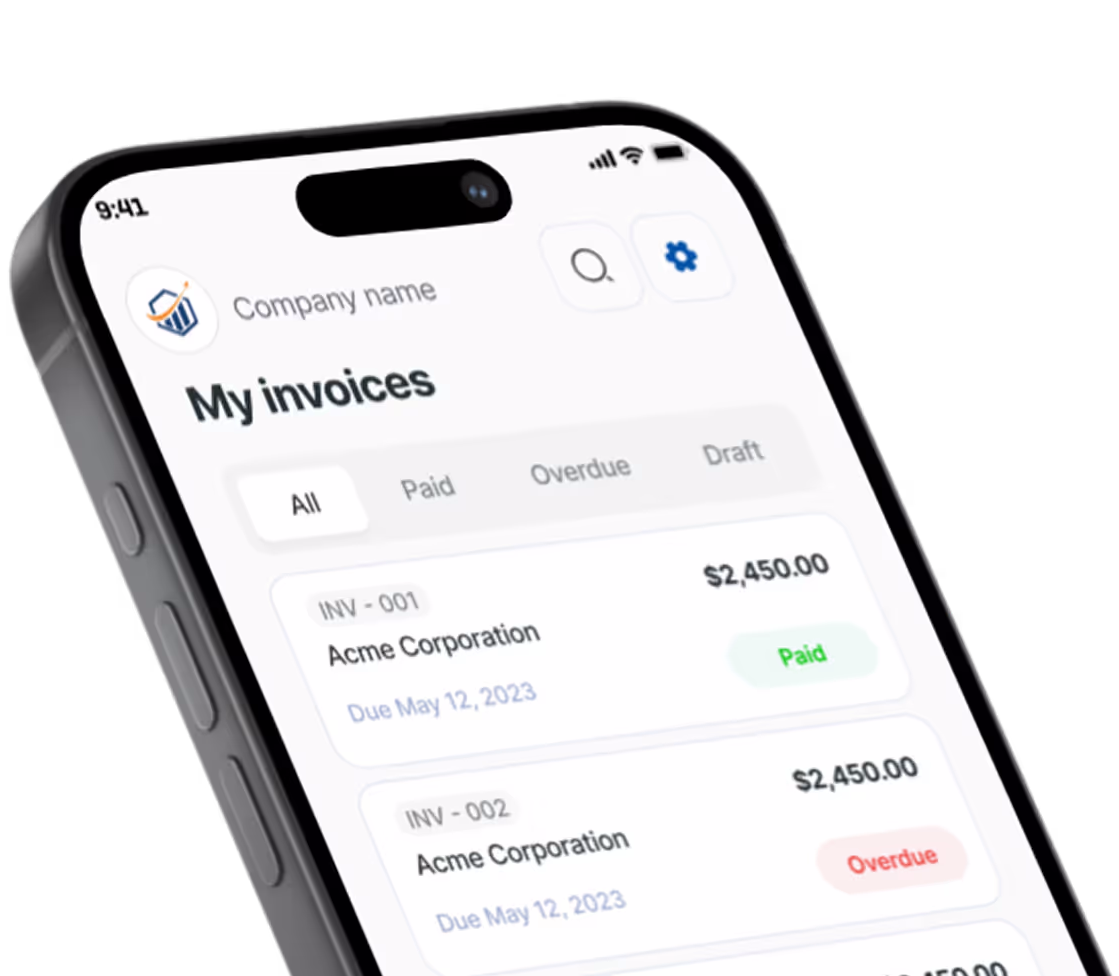
Pronto Invoice is an invoicing app, not accounting or payroll software, and it does not file taxes. What it does well is the first part: you build and send the invoice from your phone, with line items, and keep your paid and unpaid invoices in one place. For step-by-step sending, see How to Send an Invoice.
Using Gross vs Net When You Price a Job
Quote with net in mind, because gross is what you charge and net is what you live on. If you need $1,000 in your pocket from a job, you cannot charge $1,000. You have to cover fees, materials and tax first.
Work backward from the take-home you want. If a job like the one above keeps about 59 cents of each billed dollar, a target of $1,000 means billing roughly $1,700. Your own ratio will differ, so run your own numbers once and reuse them. How to Calculate Your Hourly Rate and How to Price Your Services build on the same idea.
Frequently Asked Questions
Is gross pay before or after taxes?
Gross pay is before taxes. Net pay is after taxes and other deductions.
Which is bigger, gross pay or net pay?
Gross pay is bigger. Net pay equals gross minus deductions, so it can only match gross if nothing is deducted.
What is the formula for gross pay?
For an employee, gross pay is hourly rate times hours worked, or the salary for the period, plus overtime and bonuses. For an invoice-earner, gross is the sum of the invoice line items.
Why is my net lower than the quote I gave the client?
Your quote is gross. Payment fees, materials and tax set-aside come out before you keep anything. Build those into the price so net lands where you need it.
What does “gross to net” mean?
Gross to net is the process of subtracting every deduction from gross to reach take-home pay. The worked example above is a gross-to-net calculation for one job.
Your Next Step
Take your last paid invoice and run the same table: total, fees, costs, tax set-aside, what is left. You will know in five minutes whether that job was worth it.
If you would rather build and send the next one from your phone before you leave the job site, Pronto Invoice has a free invoice generator you can try without signing up at prontoinvoice.com. Check the pricing page for what each plan includes.
Tax figures reflect IRS and SSA guidance at the time of writing; the tax rates in the example are illustrations. Confirm current rules and your own numbers with a CPA.
There is always something more to read

10 Steps to Set Up a Small Business: The Complete Startup Checklist for 2025
Learn 10 steps to set up a small business with this checklist covering LLC, banking, invoicing, insurance, and pricing.

1099 Requirements for Small Business (2026): Complete Guide
$600 threshold is now $2,000 for 2026. Learn 1099 requirements: 1099-NEC, W-9 rules, deadlines, filing.

How to Accept Payments Online
No website needed. Here is how to start accepting online payments as a small business — processors, payment links, and invoicing in one afternoon.