Do You Need an EIN? LLC EIN vs SSN
Single-member LLC EIN rules, sole proprietor EIN vs SSN, which number goes on a W-9, and how to get an EIN free from the IRS in one sitting.


A client just asked for your W-9, and you are staring at the tax ID box. Short answer: a single-member LLC or sole proprietor with no employees does not have to get an EIN. You can use your SSN. A multi-member LLC does need an LLC EIN. Getting one costs nothing at IRS.gov, and it keeps your SSN off client paperwork.
This guide sorts out who needs an EIN, which number goes where, and how to apply without paying a lookalike site.
In This Guide
- Do you need an EIN? The quick answer
- Does a single-member LLC need an EIN?
- Does a multi-member LLC need an EIN?
- Sole proprietor EIN vs SSN: which should you use?
- Which number goes on a W-9 and your invoices?
- EIN vs Form 8832: not the same thing
- How to apply for an EIN (free)
- Form the LLC first, then get the EIN
- Quick EIN questions
Do You Need an EIN? The Quick Answer
An EIN (Employer Identification Number) is a nine-digit federal tax ID for a business, like a Social Security number for your company. Whether you need one depends on how your business is set up and what it does.
| Your setup | EIN required? | Why |
|---|---|---|
| Sole proprietor, no employees | No, SSN works | You and the business are the same taxpayer |
| Single-member LLC, no employees | No for most, SSN works | The IRS treats the LLC as you by default |
| Single-member LLC with employees | Yes | The LLC is its own employer for payroll taxes |
| Single-member LLC with federal excise taxes | Yes | The IRS requires the LLC’s own EIN |
| Multi-member LLC | Yes | Treated as a partnership unless it elects otherwise |
| Anyone opening a business bank account | Often | Many banks ask for one, even when the IRS does not |
The IRS lays out these triggers on its single-member LLC page. Your bank or state may add its own rules, so the IRS answer is not always the whole answer.
Does a Single-Member LLC Need an EIN?
A single-member LLC does not need an EIN with the IRS unless it hires employees, owes federal excise taxes, or elects to be taxed as a corporation. By default the IRS ignores the LLC for income tax. The business’s income and expenses go on your personal return, and you can use your SSN.
The IRS calls this a “disregarded entity.” In plain words: the LLC protects you legally, but for federal income tax you and the LLC are one taxpayer.
Three things change that:
- Employees. For payroll taxes, the IRS treats your LLC as a separate employer, so it needs its own EIN. If that is coming up, read when to hire your first employee.
- Federal excise taxes. Some businesses owe these on specific products or activities. The LLC must use its own EIN.
- Corporate tax treatment. If you file to have the LLC taxed as a corporation, it needs an EIN.
Where the IRS says “optional,” other people may say “required.” Banks commonly ask for an EIN to open a business account. Some states want one for state registrations. Retirement plans set up through the business usually need one too. None of that is an IRS rule, so check with your bank and state before assuming.
Does a Multi-Member LLC Need an EIN?
A multi-member LLC needs an EIN. With two or more owners, the IRS treats the LLC as a partnership by default, and a partnership files its own return under its own number. The LLC EIN is also what goes on forms the LLC gives to clients and payers.
If you and a partner run a two-person crew under one LLC, get the EIN before you open the bank account or sign big contracts. Details on the structures themselves are in LLC vs sole proprietor vs S-corp explained.
Sole Proprietor EIN vs SSN: Which Should You Use?
A sole proprietor with no employees can use an SSN for everything federal. No EIN required. You still might want one, and the IRS lets you get one voluntarily.
Here is the tradeoff:
| Use your SSN | Get a sole proprietor EIN | |
|---|---|---|
| Cost | Nothing | Nothing at IRS.gov |
| Setup time | None | Online application, one sitting |
| Privacy | Your SSN goes on client W-9s | Clients get a business number instead |
| Does it change your taxes? | No | No, same Schedule C |
| Bank account | Some banks refuse | Most banks accept it |
The privacy point is the real reason most one-person businesses get one. Every client who pays you $600 or more in a year will ask for a W-9, and the 1099s come back with that number on them. Our 1099 requirements guide covers who sends what. Handing your SSN to a dozen clients is a lot of exposure for a number you can replace with a free one.
An EIN does not change how you are taxed. You still owe income tax and self-employment tax on your profit, and you still need to plan for estimated tax payments.
Which Number Goes on a W-9 and Your Invoices?
On a W-9, a single-member LLC owned by an individual writes the owner’s name on line 1 and the LLC name on line 2. The tax ID is the owner’s SSN or the owner’s EIN. Do not use the LLC’s EIN there. The IRS spells this out in the Form W-9 instructions.
Here is how it breaks down by setup:
- Sole proprietor: your name on line 1, business name on line 2 if you have one, your SSN or your sole proprietor EIN.
- Single-member LLC (individual owner): your name on line 1, LLC name on line 2, your SSN or your own EIN.
- LLC taxed as a partnership or corporation: the LLC’s name and the LLC’s EIN.
Check the current W-9 on IRS.gov before you fill one out, since the IRS updates the form from time to time.
Your invoice is a different story. The EIN goes on the W-9, not the invoice. An invoice needs your business name, contact details, the client, the work, the amount and the due date. Our 15 essential invoice fields lists everything it should carry, and no tax ID is on that list.
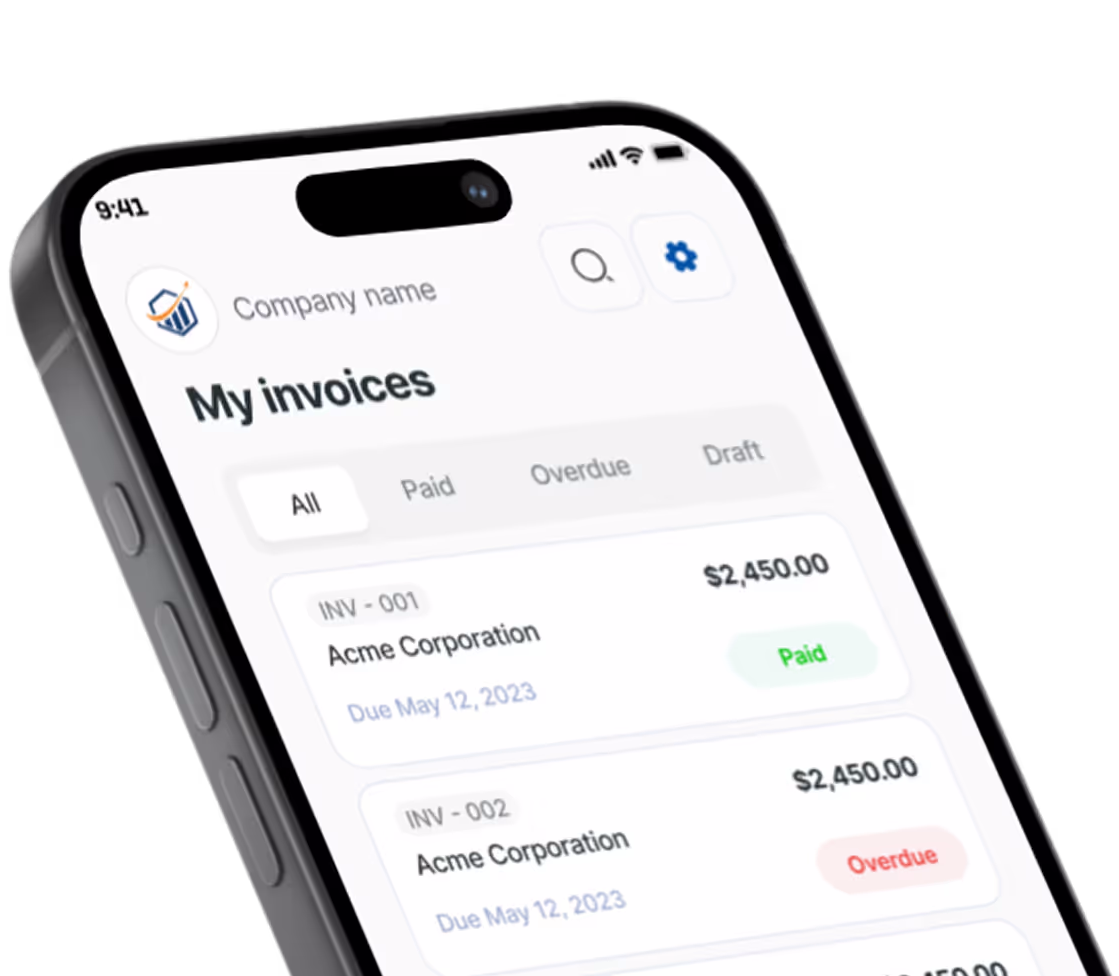
That keeps things easy on your phone. In Pronto Invoice, your business name and details are saved once and print the same on every invoice. You send the W-9 separately when a client asks, and your SSN never shows up on a customer’s copy.
EIN vs Form 8832: Not the Same Thing
An EIN is an ID number. Form 8832 is a different form that changes how your LLC is taxed. People mix them up because both come up when you form an LLC.
- EIN: identifies the business. It does not choose a tax classification.
- Form 8832: an election to have the LLC taxed as a corporation instead of the default.
Most one-person LLCs never file Form 8832. You get an EIN from the online application or Form SS-4, not from 8832. The IRS explains the application on its Form SS-4 instructions. If someone tells you that you must file 8832 just to get an EIN, that is a red flag. Talk to a CPA before electing anything, since that choice changes your tax bill.
How to Apply for an EIN (Free)
Apply for an EIN directly at IRS.gov. It is free, and the IRS issues the number right away when the online application goes through, per the IRS EIN page. No fee, ever, on the official site.
Here is the process:
- Go to IRS.gov and search “Apply for an EIN online.” Make sure the web address ends in .gov.
- Pick your entity type: sole proprietor, LLC, partnership, and so on.
- Enter the responsible party: the person who owns or controls the business. For a single-member LLC, that is you. You will need an SSN, ITIN, or other taxpayer ID.
- Give your legal business name, address, and reason for applying.
- Submit, then save or print the confirmation letter the IRS shows you.
Watch out for lookalike sites. The IRS warns that third-party websites may charge fees for a service the IRS provides for free. If a site asks for a credit card at the end, after you typed everything in, close the tab. Start from IRS.gov instead.
Form the LLC First, Then Get the EIN
Form the LLC with your state first, then apply for the EIN. This is practical guidance more than an IRS rule. The application asks for your legal business name and details, which only exist once the state approves your LLC.
The order looks like this:
- File your LLC with your state and wait for approval.
- Apply for the EIN at IRS.gov using the exact legal name on your state paperwork.
- Open the business bank account with your EIN confirmation letter.
- Send W-9s to clients as they ask.
If you get the EIN under a sole proprietor name first and form an LLC later, you may need a new one. Ask a CPA or your state’s business office if you are in that spot.
Quick EIN Questions
Can I use my SSN for my LLC?
Yes, if you are a single-member LLC with no employees and no excise taxes. The IRS lets a single-member LLC use the owner’s SSN for federal income tax.
Is an EIN really free?
Yes. The IRS charges nothing for it. Any site that charges a fee is a third party, not the IRS.
Do I need an EIN to open a business bank account?
Often, yes, even when the IRS does not require one. Banks set their own rules. Call yours before you go in, or just get the free number first.
How do I find my EIN if I lost it?
Look for your IRS confirmation letter, past tax returns, or your bank’s business account paperwork. You can also call the IRS Business & Specialty Tax Line to ask. Do not pay a site to look it up for you.
What if I want to keep my SSN off client forms?
Get an EIN, then use it on your W-9. As a sole proprietor or single-member LLC owner, you can put your own EIN in the tax ID box instead of your SSN.
Does getting an EIN change my taxes?
No. An EIN does not change your tax classification or how much you owe. It is an ID number.
Get the Paperwork Out of the Way, Then Get Paid
An EIN takes one sitting at IRS.gov, and then it is done. Once you have it, your W-9 is ready for the next client who asks, and your SSN stays out of the file.
Then the real work starts: sending invoices and collecting. If you want to see what a fast invoice looks like, Pronto Invoice lets you build and send one from your phone, with your business details already filled in. For the money side, our guide on how to keep track of invoices and payments shows how to see who has paid and who hasn’t.
Tax rules change and your situation may not match the examples here. For anything beyond the basics, check with a CPA or tax professional.
There is always something more to read

10 Steps to Set Up a Small Business: The Complete Startup Checklist for 2025
Learn 10 steps to set up a small business with this checklist covering LLC, banking, invoicing, insurance, and pricing.

1099 Requirements for Small Business (2026): Complete Guide
$600 threshold is now $2,000 for 2026. Learn 1099 requirements: 1099-NEC, W-9 rules, deadlines, filing.

How to Accept Payments Online
No website needed. Here is how to start accepting online payments as a small business — processors, payment links, and invoicing in one afternoon.