
Medical Invoice Template
Create professional medical invoices in under 60 seconds. Download free templates or use our mobile app for patient billing and superbills.
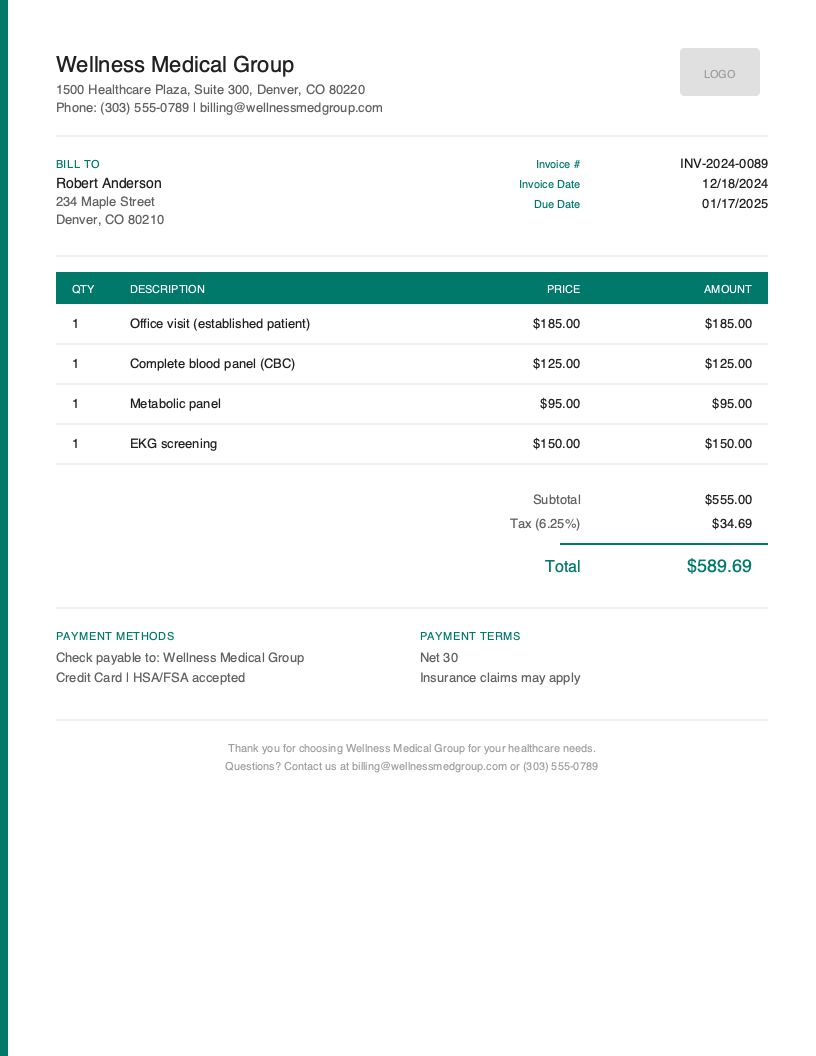
Download Free Medical Invoice Template
Get Your Free Medical Invoice Template
Download in your preferred format. Customize with your logo, colors, and business details. Start invoicing professionally in minutes.
Microsoft Word
Easy to customize, add your logo
Microsoft Excel
Auto-calculate totals and taxes
Medical Invoice Template Variations
Choose from multiple professional designs. Customize colors, add your logo, and make it yours.
Default
Clean default layout
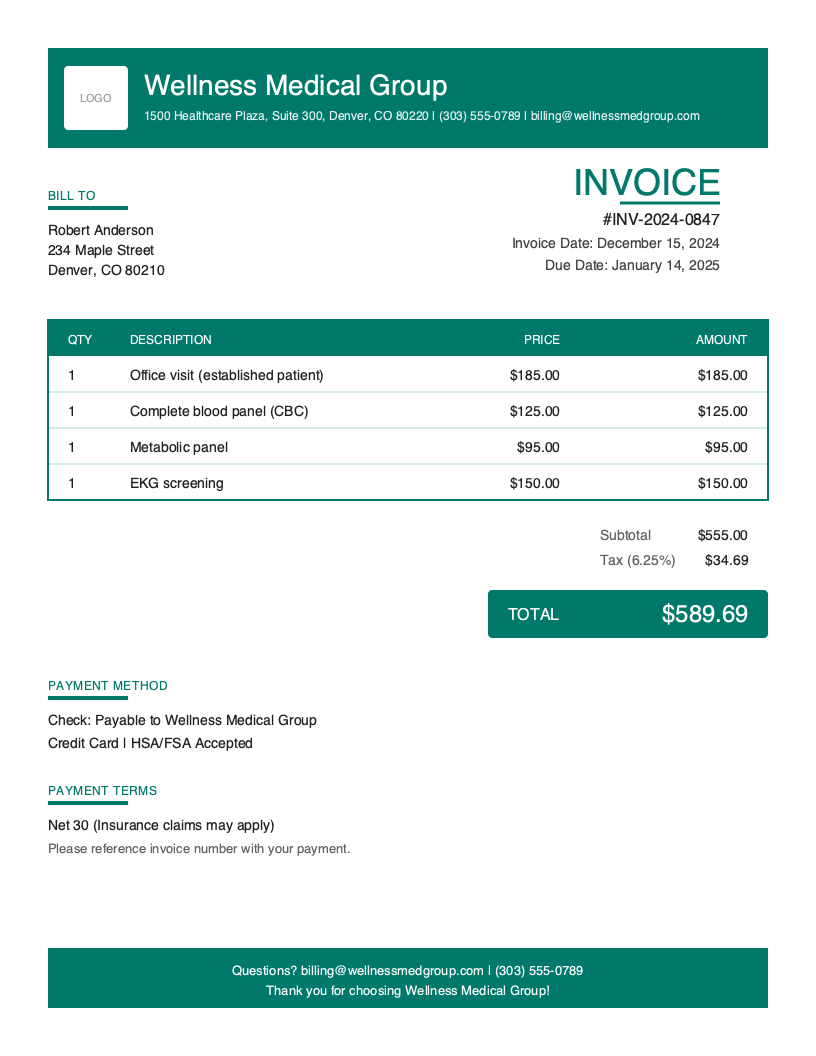
Bold
Branded, high-contrast header
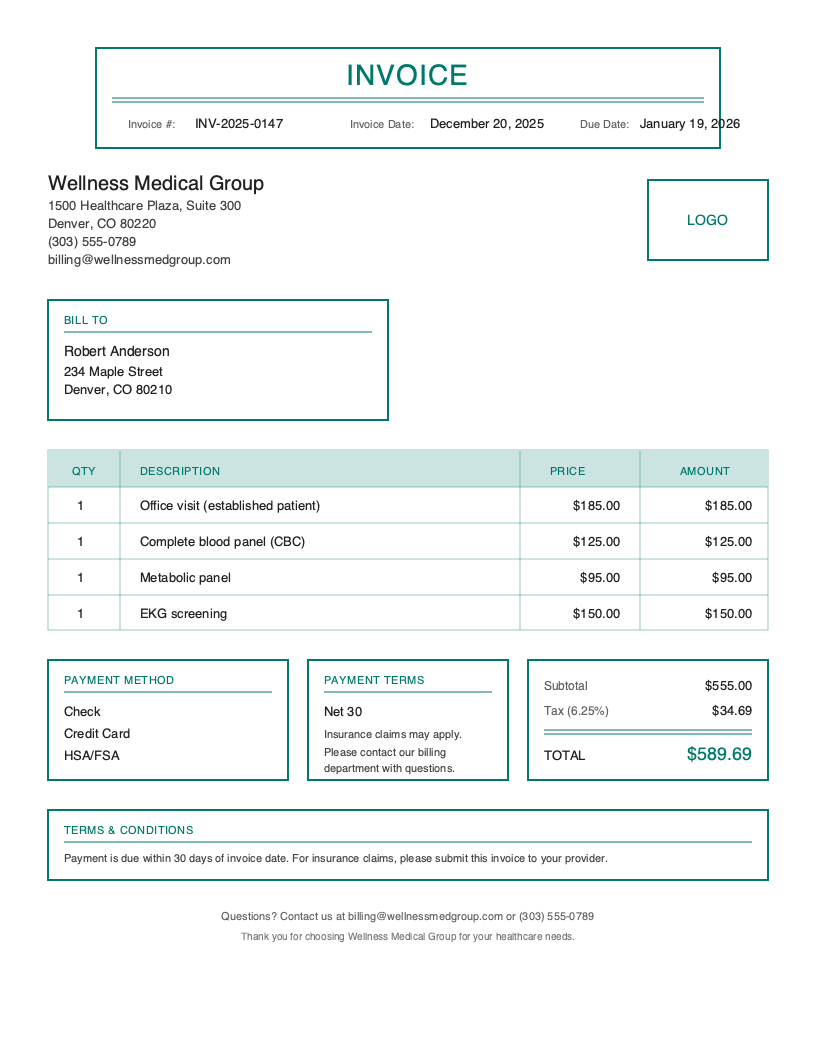
Classic
Traditional professional layout
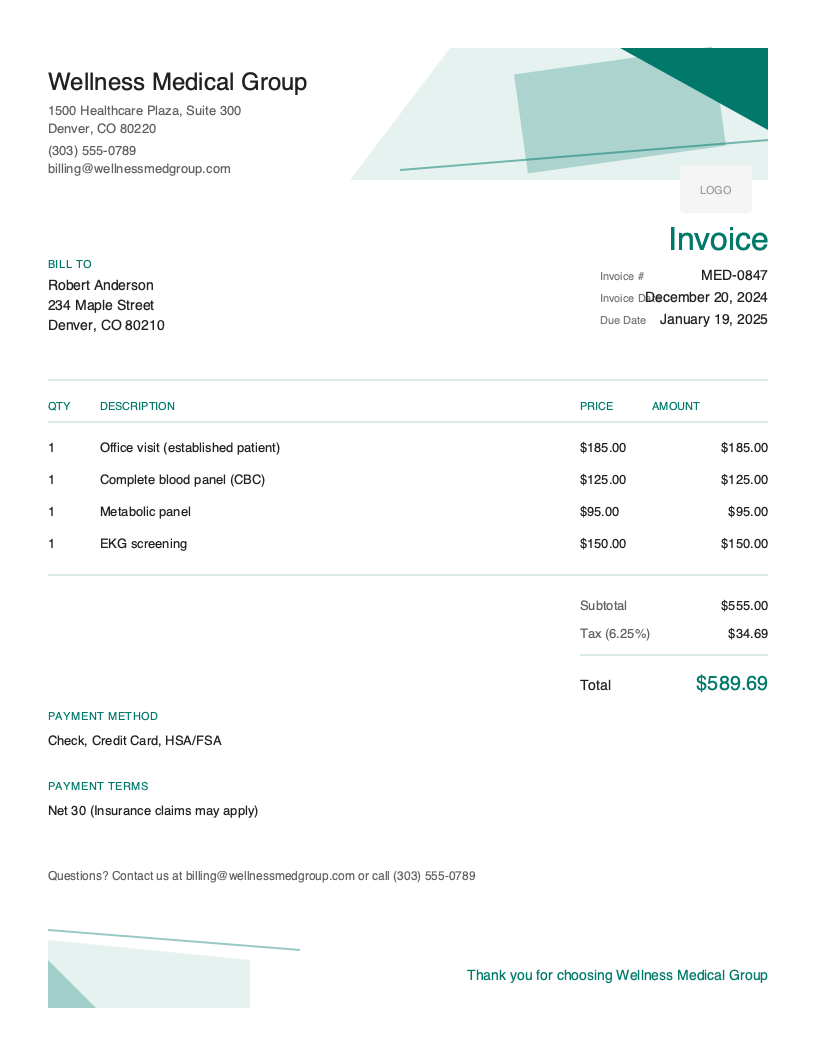
Artistic
Eye-catching color accent
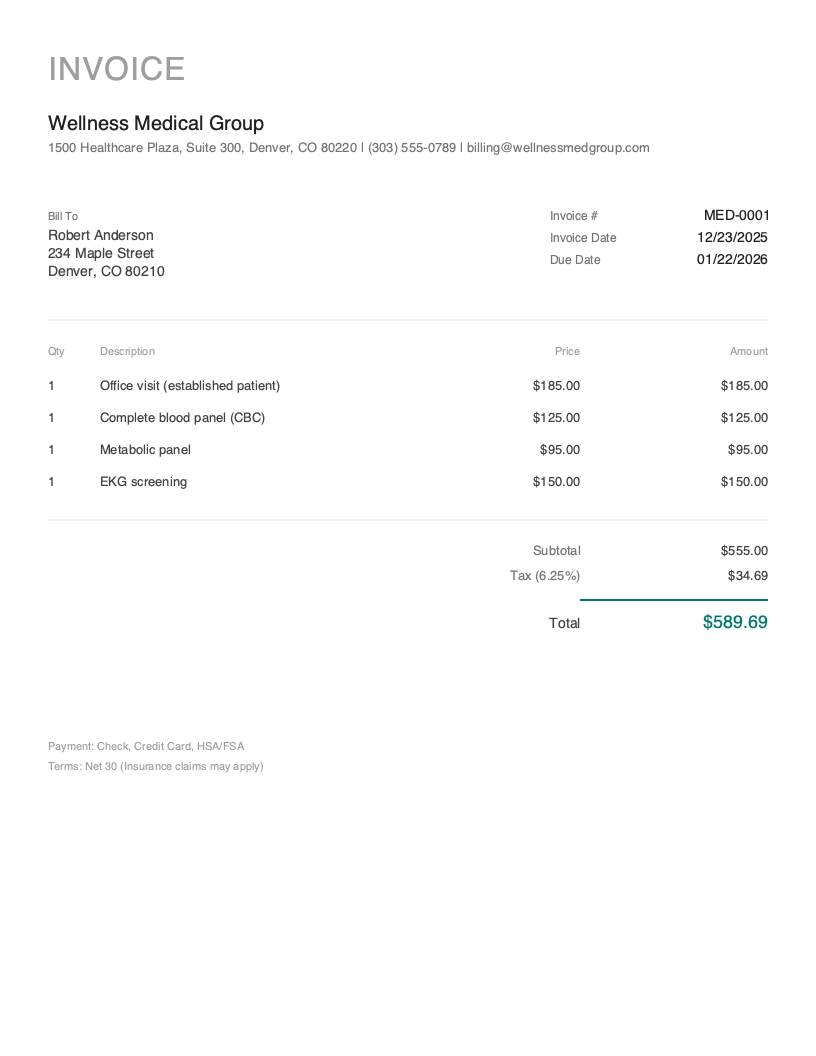
Minimal
Clean, utility-first design
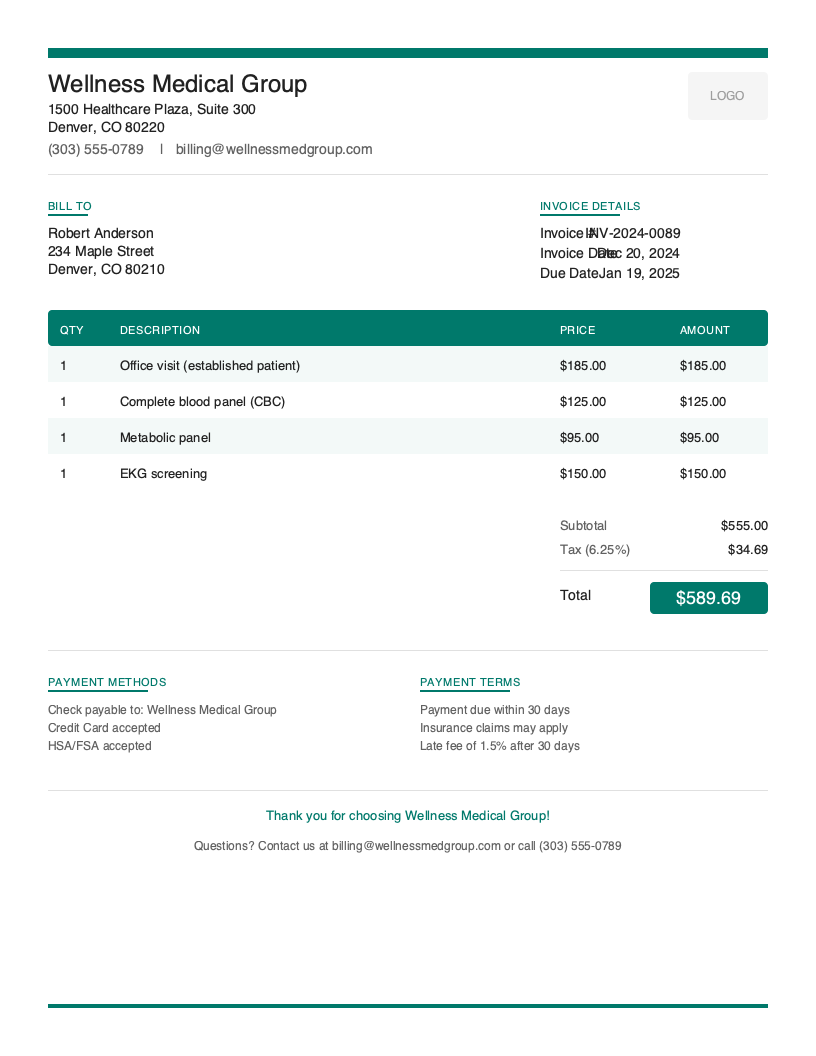
Modern
Clean, contemporary look
No signup required. Create and download instantly.
When you run an independent practice, the work doesn’t end when the patient walks out the door. Charting, coding, and billing still wait for you—and getting paid depends on sending a clear, professional invoice that patients actually understand. A confusing bill is the fastest way to trigger phone calls, disputes, and weeks of delay before money reaches your account.
Medical billing is uniquely complicated. You’re juggling insurance adjustments, copays, deductibles, coinsurance, and self-pay balances, often on the same statement. Patient out-of-pocket spending now exceeds $470 billion a year, which means more of your revenue depends directly on what patients pay you—not the insurer. A vague or disorganized invoice puts that revenue at risk.
That’s why we’ve created free medical invoice templates and a practical guide to invoicing for healthcare practices. Whether you’re a solo practitioner, a small clinic, or an out-of-network provider issuing superbills, this page will help you bill patients clearly, get paid faster, and keep your records in order.
What You’ll Find on This Page
- Free downloadable medical invoice templates (Word and Excel)
- Every field a professional medical invoice should include
- The difference between a patient invoice and a superbill
- Insurance versus self-pay billing best practices
- How to create professional invoices in under 60 seconds from your phone
Download Free Medical Invoice Templates
Get started immediately with our professionally designed medical invoice templates. Choose the format that fits your workflow—the Word template is ideal for quickly editing a polished, printable statement, while the Excel template includes built-in formulas that automatically total your line items, apply insurance adjustments, and calculate the patient’s remaining balance.
Both formats give you a clean, itemized layout with space for your practice details, patient information, service codes, and payment terms. Customize them with your logo and colors, then save as a PDF to email or print for your patients.
What to Include on Your Medical Invoice
A professional medical invoice must include specific information to ensure quick payment, support insurance reimbursement, and keep your practice organized. Unlike a generic invoice, a medical invoice needs provider credentials, service codes, and a clear breakdown of what insurance covered versus what the patient owes.
Required Invoice Sections
Practice Information - Include your practice or provider name, physical address, phone number, and email. Add your National Provider Identifier (NPI) and tax ID or EIN, which patients and insurers may need for reimbursement and recordkeeping.
Patient Identification - List the patient’s full name, account or chart ID, and date of birth. A unique patient or account number makes it easy to match payments to the correct record without exposing unnecessary personal detail.
Invoice Number and Dates - Assign a sequential invoice number for clean accounting. Always include the date of service and the invoice date—these are distinct, and the date of service is what insurers and patients reference.
Itemized Services - Present each service, procedure, or supply on its own line with a plain-language description, quantity, and price. This is the single most important section for preventing disputes.
Totals and Balance Due - Show the subtotal, any insurance adjustments and payments, applicable tax where relevant, and the final patient balance due. Make the amount the patient owes impossible to miss.
Critical Medical Invoice Elements
Service and Procedure Descriptions - For every line item, pair the procedure or service code (such as a CPT code) with a clear, readable description. A patient who sees “99213 — Office visit, established patient” understands far more than one who sees a code alone. Clarity here prevents the “what is this charge?” call.
Provider Details - Identify the rendering provider by name and credentials (MD, DO, NP, PA, DPT, and so on). For multi-provider practices, this clarifies who delivered the care and supports accurate records.
Date of Service - Every medical invoice should state exactly when each service was performed. Insurers require it for claims, and patients use it to reconcile bills against their visits and explanations of benefits.
Patient and Account ID - A consistent account or chart identifier ties the invoice to the patient’s record while letting you keep sensitive details off the statement. Share only what’s needed to identify the bill.
Insurance and Adjustment Lines - When a claim has been processed, show the original charge, the contractual adjustment, the insurance payment, and the remaining patient responsibility. When you don’t bill insurance directly, label the document as a superbill so the patient knows to submit it for reimbursement.
Understanding Medical Practice Invoicing
US healthcare spending now tops $4.9 trillion annually, and a fast-growing share of that lands on patients directly through high-deductible plans. As patient responsibility climbs past $470 billion a year, the quality of your invoice has a direct impact on whether—and how quickly—you collect.
Collection timing is the quiet killer of practice cash flow. Self-pay patient balances commonly take 30 or more days to collect, and every additional week lowers the odds of getting paid in full. Administrative and billing work also costs the US healthcare system over $200 billion a year, a burden that falls heavily on small practices without large back-office teams. Clear, prompt invoicing is one of the few levers a solo or small practice can pull to improve both speed and cost. For more on structuring terms, see our payment terms guide.
Insurance Billing vs. Self-Pay
In an insurance-based workflow, you submit a claim, wait for the explanation of benefits, and then invoice the patient only for their share—deductible, copay, and coinsurance. The patient invoice should mirror the EOB so the numbers reconcile cleanly. In a self-pay or cash-pay model, the patient owes the full amount at or near the time of service, and your invoice is the entire transaction. Many practices run both models simultaneously, which is exactly why your template needs distinct lines for charges, adjustments, payments, and balance due.
The Superbill for Out-of-Network Providers
Out-of-network and cash-based practices—common in therapy, physical therapy, mental health, and specialty care—often hand the patient a superbill instead of billing the insurer. A superbill is an itemized receipt with diagnosis and procedure codes that the patient submits to their plan for reimbursement. It includes everything a standard invoice does, plus the coding detail an insurer needs to process an out-of-network claim. Issuing a clean, complete superbill saves your patients hours of frustration and reduces follow-up requests to your office.
Recurring and Plan-Based Billing
Practices offering memberships, treatment plans, or packages—think concierge medicine, dental plans, or multi-visit therapy programs—benefit from consistent, repeatable invoicing. Reusing a standardized template for each cycle keeps balances predictable for patients and makes your own bookkeeping far easier at month and year end.
Medical Invoicing Best Practices
Itemize Every Service Clearly
Patients dispute what they don’t understand. Break every visit into discrete line items—office visit, procedure, lab, supply—each with a plain-language description beside its code. Transparency turns a potential argument into a quick payment.
Separate Insurance and Patient Responsibility
Never hand a patient a single confusing number. Show the full charge, the insurance adjustment, the amount the plan paid, and the remaining balance. When patients can trace exactly how their balance was calculated, they pay faster and call less.
Bill Promptly After the Visit
The best time to send a statement is right after service, while the appointment is fresh and the patient expects a bill. Prompt invoicing shortens your collection cycle and signals an organized, professional practice.
Protect Patient Privacy on Every Statement
Treat every invoice as sensitive. Share only the minimum information needed to identify the bill, deliver statements through secure channels rather than unprotected email, and keep your records access-controlled. Privacy-minded billing protects both your patients and your practice. (This is general guidance, not legal advice—confirm your obligations with a qualified advisor.)
Offer Flexible Payment Options
High deductibles mean larger out-of-pocket balances, so make paying easy. Accept credit and debit cards, digital wallets, and offer payment plans for larger balances. The simpler you make payment, the sooner outstanding balances clear.
Create Medical Invoices in Under 60 Seconds
Pronto Invoice is a mobile-first app built for busy practitioners who would rather see patients than wrestle with billing software. You can generate a clean, professional patient invoice or superbill from your phone between appointments—no desktop, no complicated practice-management suite required.
Here’s how fast it is:
- Select or add the patient from your saved contacts
- Add itemized services with descriptions and codes from your saved list
- Apply insurance adjustments and enter the patient balance due
- Choose a professional template that matches your practice branding
- Send instantly by email or text with a built-in payment link
That’s it—a polished, itemized invoice in under 60 seconds, ready for the patient to pay on the spot.
Features Medical Professionals Need
Works Anywhere - Create and send invoices from the exam room, the front desk, or between visits. Your data syncs automatically across your devices.
Itemized Service Library - Save your common services and codes once, then add them to any invoice in a tap. No retyping descriptions or looking up codes for routine visits.
Insurance and Self-Pay Layout - Built-in fields for charges, adjustments, payments, and patient balance keep insurance and self-pay billing clear on a single statement.
Professional Templates - Choose from clean, branded layouts that present your practice as the organized, trustworthy operation it is.
Get Paid Faster - Send invoices with a secure “Pay Now” link so patients can settle balances by card or digital wallet the moment they receive the bill.
Stop letting paperwork pile up after every patient. Start sending professional medical invoices in under 60 seconds and get paid for the care you provide.
Medical Invoicing Best Practices
Itemize Every Service
Patients dispute what they don't understand. List each service, procedure, and supply on its own line with a plain-language description alongside any code.
Separate Insurance from Self-Pay
Show the total charge, insurance adjustments, the amount paid by the plan, and the patient's remaining balance so the bill is never a surprise.
Bill Promptly After Service
Send the invoice or superbill within a few days of the visit while the appointment is fresh. The longer you wait, the harder collection becomes.
Protect Patient Privacy
Share only the minimum necessary information and send statements through secure channels. Keep records organized and access controlled.
Offer Flexible Payment Options
Accept cards, digital wallets, and payment plans. Making payment easy is the fastest way to close an outstanding patient balance.
Frequently Asked Questions
A professional medical invoice should include your practice name, address, NPI or tax ID, the patient's name and account or chart ID, the date of service, an itemized list of services with descriptions and service or procedure codes, the provider's name and credentials, insurance adjustments and payments, the patient's remaining balance, payment terms, and accepted payment methods.
A medical invoice is a request for payment you send directly to a patient for services rendered. A superbill is an itemized receipt containing diagnosis and procedure codes that a patient submits to their insurance for reimbursement when you do not bill the insurer directly, which is common for out-of-network and cash-pay practices.
Wait for the insurer's explanation of benefits, then invoice the patient for the patient-responsibility amount: typically the deductible, copay, and coinsurance. Show the original charge, the insurance adjustment and payment, and the clear remaining balance so the patient understands exactly what they owe and why.
Related Invoice Templates
Start Creating Professional Medical Invoices Today
Join thousands of professionals who use Pronto Invoice to get paid faster. Create your first invoice in under 60 seconds.
This guide is for informational purposes only and does not constitute legal or tax advice.