
Free Cash Receipt Template
Create professional cash receipts in under 30 seconds. Download free templates with PAID stamp or use our mobile app to issue receipts on-site — even offline.
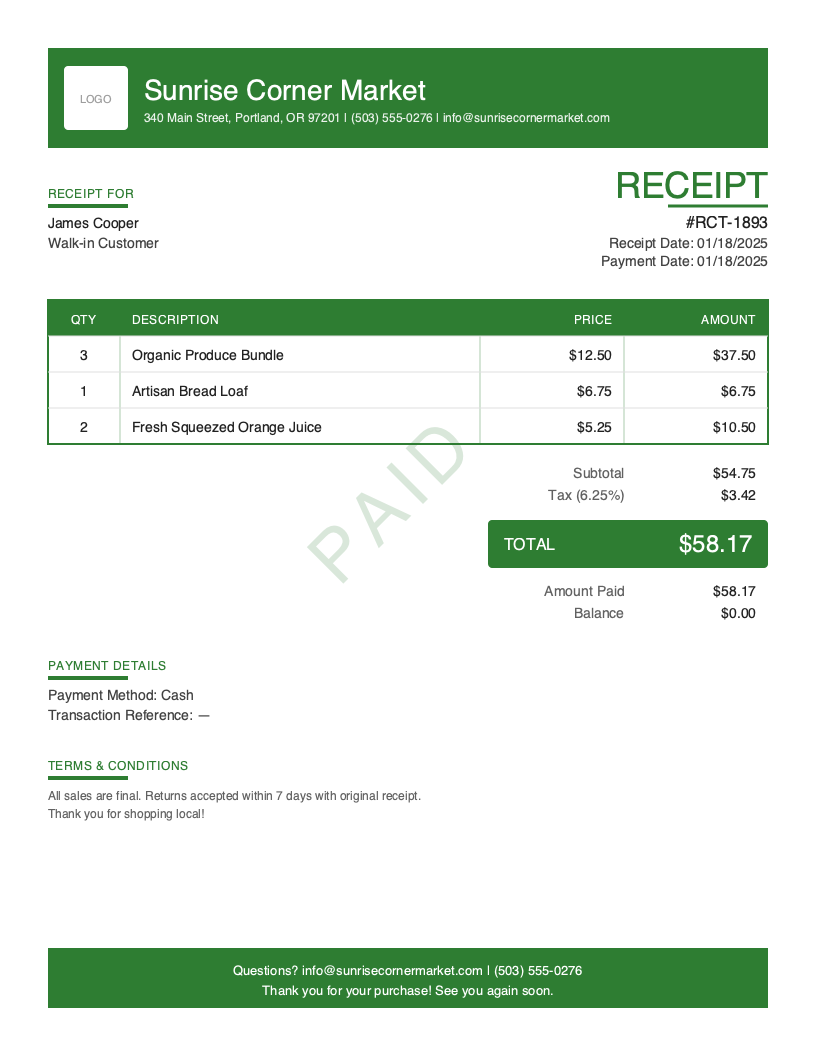
Download Free Cash Receipt Template
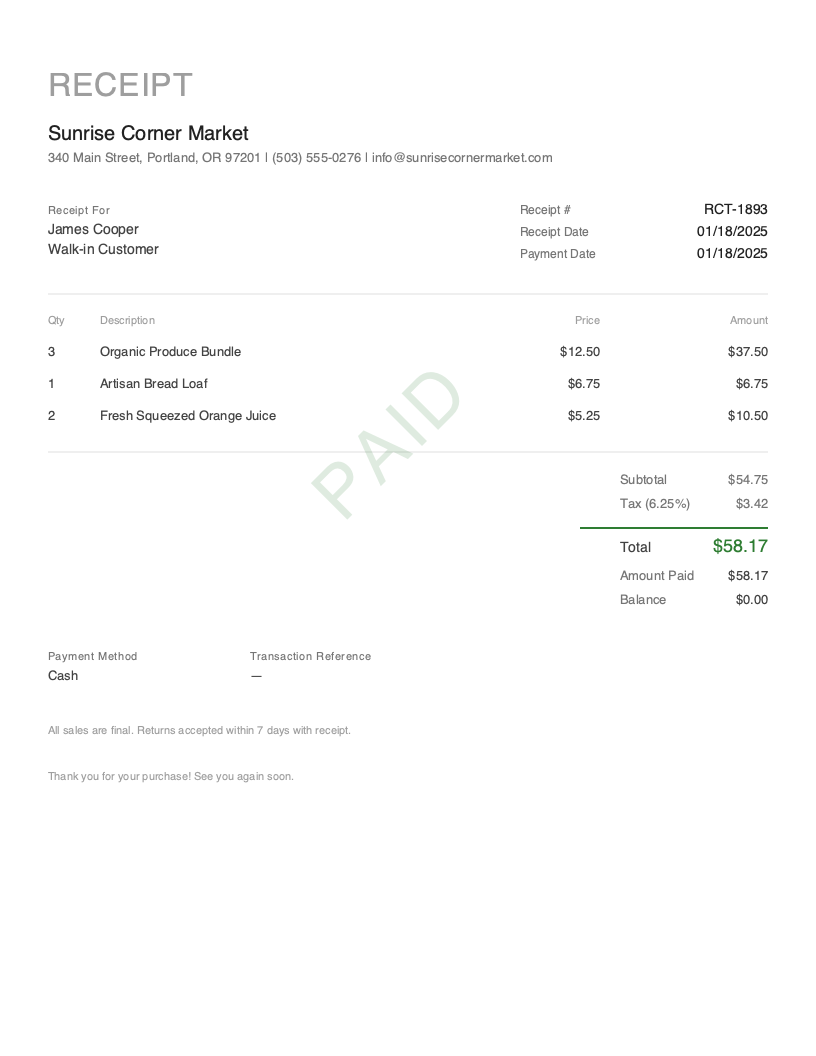
Get Your Free Cash Receipt Template
Download in your preferred format. Customize with your logo, colors, and business details. Start issuing professional receipts in minutes.
Microsoft Word
Easy to customize, add your logo
Microsoft Excel
Auto-calculate totals and taxes
Cash receipt template is one of the most searched receipt types online
Largest segment collecting cash on-site — contractors, plumbers, electricians
Time to create and send a professional cash receipt with Pronto Invoice
You just finished a $350 AC repair. The homeowner reaches into her purse, counts out the cash, and hands it over. Now what? Without a receipt, there’s no proof the payment happened — for either of you. She can’t document the expense for her home warranty claim. You can’t prove you collected payment when your bookkeeper asks next month.
Cash transactions leave no digital trail. There’s no credit card statement, no bank transfer record, no PayPal confirmation email. The cash receipt is the only documentation that exists. For contractors, plumbers, electricians, and other field service professionals who collect cash on-site, a professional cash receipt isn’t optional — it’s your legal and financial lifeline.
Here’s the critical distinction: a cash receipt confirms payment already received in cash. It’s not an invoice requesting payment or a list of payment methods you accept. It’s proof that physical currency changed hands, the transaction is complete, and both parties are covered. Every cash receipt should carry a prominent PAID stamp, specify “Cash” as the payment method, and ideally include a customer signature for additional proof.
What you’ll find on this page:
- Free downloadable cash receipt templates (Word & Excel)
- Complete breakdown of required cash receipt elements
- When and why cash receipts matter for your business
- Best practices for issuing cash receipts on-site
- How to create cash receipts from your phone in under 30 seconds
Download Free Cash Receipt Templates
Get started immediately with our professionally designed cash receipt templates. Both formats include a prominent PAID stamp, “Cash” payment method field, and signature line for on-site proof.
| Format | Best For | Download |
|---|---|---|
| Microsoft Word | Easy customization — add your logo, colors, and business details | Download Word |
| Microsoft Excel | Auto-calculate line item totals, tax, and amount paid | Download Excel |
Tip: The Excel template includes built-in formulas that automatically calculate subtotals, tax amounts, and totals. Enter your quantities and unit prices, and the receipt does the math.
Both templates include a PAID stamp, “Cash” as the pre-selected payment method, and a signature line — the essential elements that make a cash receipt legally defensible.
Want more polished designs? Create custom receipts with our receipt generator.
What to Include on a Cash Receipt
A cash receipt serves one critical purpose: proving that physical currency was exchanged for goods or services. Because cash leaves no electronic trail, your receipt is the only record that exists. Every element should reinforce this: the cash was received, here’s what was purchased, and here’s the signed proof.
Required Receipt Sections
| Section | What to Include | Why It Matters for Cash |
|---|---|---|
| Receipt Header | Receipt number (RCT-0001), receipt date, document title “RECEIPT” | Creates a searchable record — essential since cash has no automatic transaction trail |
| Business Information | Company name, address, phone, email, license number | Proves who received the cash; license number adds legitimacy for field service |
| Client Information | Customer name and address | Links the receipt to a specific payer — critical for cash since there’s no bank record |
| Line Items | Products/services with quantity, description, price, amount | Documents exactly what the cash payment covered |
| Pricing Summary | Subtotal, tax, total, amount paid, balance ($0.00) | Confirms the full cash amount was collected — balance must be zero |
| Payment Details | Payment method: “Cash”, payment date | Explicitly documents that physical currency was the payment method |
| PAID Indicator | Prominent PAID stamp or badge | Immediately communicates the transaction is settled |
| Signature Line | Customer signature with date | Cash-specific — provides physical acknowledgment that the customer received goods/services and you received cash |
| Terms & Conditions | ”All sales final” or applicable refund policy | Protects your business — especially important for cash since refunds are harder to trace |
| Thank You Message | Brief gratitude message | Professional touch that reinforces trust |
Critical Cash Receipt Elements
Payment Method: Cash Unlike receipts for card or digital payments, a cash receipt must explicitly state “Cash” as the payment method. There’s no transaction reference number, no confirmation code, no digital breadcrumb. The word “Cash” on the receipt is the documentation. Some businesses add the denomination breakdown (e.g., “3 × $100 + 1 × $50”) for high-value transactions, but the payment method field at minimum should read “Cash.”
Customer Signature This is what separates a strong cash receipt from a weak one. A signature line with the customer’s name, signature, and date creates a physical acknowledgment that the transaction occurred. If a dispute arises — “I never paid them” or “They never finished the job” — a signed receipt is your best defense. For field service professionals collecting cash on-site, always get the signature before you leave.
Exact Amount Received Cash transactions must document the precise amount. If the total is $347.50 and the customer hands you $350, your receipt shows $347.50 as the total and amount paid, with $0.00 balance. The $2.50 change isn’t documented on the receipt — only the transaction amount. For large cash payments, some businesses note the payment on the receipt in words and numbers (e.g., “Three Hundred Forty-Seven Dollars and 50/100”).
Receipt Number Sequence Every cash receipt needs a unique sequential number (RCT-0001, RCT-0002). This is essential for your bookkeeping and tax records. The IRS expects businesses receiving cash to maintain organized records. Sequential numbering makes it easy to identify gaps — a missing number could indicate an unrecorded transaction, which is a red flag during audits.
Understanding Cash Receipts
When You Need a Cash Receipt
Cash receipts are most critical in these scenarios:
On-site service completion. A plumber fixes a burst pipe, an electrician replaces a panel, a contractor finishes a deck repair. The homeowner pays cash. You need to hand them a professional receipt before packing up your tools — not email one later, not promise to send one tomorrow.
Walk-in retail or market transactions. A customer at a farmers market, corner store, or pop-up shop pays cash. A printed or mobile receipt closes the transaction professionally.
Deposits or partial payments in cash. A client pays a $500 cash deposit for a larger job. The receipt documents this partial payment and the remaining balance (note: for partial payments, use a deposit receipt template instead).
Tax and expense documentation. Both you and your customer need cash receipts for tax purposes. You need them to report income accurately. Your customer needs them to claim business expenses, home improvement deductions, or insurance reimbursements.
Who Uses Cash Receipts
Cash receipts are the #1 receipt type for field service professionals — the 40% of small business owners who work on-site at customer locations. Contractors, HVAC technicians, plumbers, electricians, landscapers, cleaning crews, and handymen collect cash daily. They need a receipt they can create on-site, on their phone, in under 30 seconds.
Freelancers and small retailers also issue cash receipts, but field service is the dominant use case. Over 7,300 people search for “cash receipt template” every month — more than any other receipt type except the general receipt template hub.
Cash Receipts vs. Invoices
An invoice says: “You owe me $350. Here’s how you can pay.” A cash receipt says: “You paid me $350 in cash. Here’s your proof.” If you’re collecting cash on the spot, you don’t need an invoice first. Create a standalone cash receipt directly. If the customer already received an invoice and pays it in cash, the receipt should reference the original invoice number (e.g., “Payment For: Invoice #042”) — this makes a payment receipt.
Legal Considerations
While no federal law requires businesses to issue cash receipts for every transaction, many states have specific requirements — particularly for home improvement contractors. Some states require written receipts for cash transactions over $25. The IRS requires documentation for all business income, and cash receipts are your primary evidence. When in doubt, always issue a receipt. The 30 seconds it takes is nothing compared to the headache of an audit without documentation.
Create Cash Receipts in Under 30 Seconds
Downloadable templates work for desk-based businesses, but if you’re collecting cash in a customer’s driveway, basement, or backyard, you need something faster. You need a receipt on your phone.
Pronto Invoice is built for exactly this scenario. Create professional cash receipts from your phone in 5 simple steps — on-site, in real time, even without cell signal.
- Select Client — choose from saved clients or add a new one on the spot
- Add Items — pick from your saved services or type a quick description
- Payment Info — select “Cash” as the payment method (one tap)
- Document Details — receipt number auto-generates, add notes or signature
- Review & Send — hand the customer their receipt before you pack up
The key difference from invoicing: Step 3 asks “How was this paid?” — not “How can they pay?” You’re confirming a completed cash transaction, not requesting future payment.
Features for Professional Cash Receipts
- PAID Stamp — every receipt includes a prominent PAID indicator, automatically applied
- Offline Capability — create cash receipts in basements, attics, and rural areas with zero cell signal. Syncs when you’re back online.
- On-Site Signature — capture the customer’s signature on your phone screen. Stored with the receipt permanently.
- Photo Attachments — attach up to 4 photos of completed work. Document before/after for your records and the customer’s.
- Auto-Receipt on Payment — if you invoice first and record a cash payment, the receipt auto-generates with all invoice details pre-filled.
- Multiple Payment Methods — if the customer splits payment (part cash, part card), track both methods on a single receipt.
- Invoice-to-Receipt — convert any paid invoice to a receipt with one tap.
Create Your First Cash Receipt Free →
Related Receipt Templates
Looking for other receipt types? Browse our complete collection:
- Sales Receipt Template — general-purpose receipt for any transaction
- Service Receipt Template — for completed repair and maintenance work
- Contractor Receipt Template — construction and home improvement receipts
- Deposit Receipt Template — partial payments and retainers
- All Receipt Templates
- All Invoice Templates
Start Creating Professional Cash Receipts Today
Stop writing IOUs on scrap paper. Every cash transaction deserves a professional receipt — for your protection, your customer’s records, and the IRS. Pronto Invoice creates cash receipts from your phone in under 30 seconds, works offline in the field, and captures customer signatures on the spot.
Create Free Cash Receipt → | Download the App →
This guide is for informational purposes only and does not constitute legal or tax advice. Consult with a qualified professional for guidance specific to your situation and jurisdiction.
Last updated: March 2026
Cash Receipt Best Practices
Create the Receipt Before You Leave
Issue the receipt immediately, on-site, before you walk away. Once you leave, the urgency disappears and details get forgotten.
Always Get a Signature
Cash has no third-party verification. A customer signature is the only acknowledgment the transaction occurred — make it non-negotiable.
Use Professional Templates — Not Handwritten Notes
A professional template with your logo, PAID stamp, and clear line items holds up far better than a scrap of paper if a dispute arises.
Document the Work, Not Just the Payment
Break charges into specific line items instead of a single total. Detailed descriptions protect you and help customers with insurance or warranty claims.
Keep Copies of Every Cash Receipt
Maintain digital duplicates of every cash receipt. The IRS recommends keeping records for at least three years, seven for certain situations.
Number Receipts Sequentially
Use consistent numbering (RCT-0001, RCT-0002) and never skip numbers. Gaps in sequence raise audit red flags.
Include License and Insurance Information
For field service professionals, adding license, bonding, and insurance details adds professionalism and satisfies state requirements.
Frequently Asked Questions
A professional cash receipt should include: your business name and contact information, the customer's name, a unique receipt number (RCT-0001 format), the receipt date, line items describing what was purchased or serviced, subtotal, tax, and total amount, 'Cash' as the payment method, a prominent PAID stamp, and ideally a customer signature. For field service professionals, also include your license number and the service address.
No. An invoice is issued before payment — it's a request for money with due dates and payment terms. A receipt is issued after payment — it's confirmation that money was received. A cash receipt specifically confirms that physical currency was exchanged. If you're collecting cash on the spot, you typically don't need to issue an invoice first — go straight to a cash receipt.
Requirements vary by state and industry. Many states require written receipts for home improvement work over a certain threshold (often $25-$500). Even where not legally mandated, the IRS expects businesses to document all income, and cash receipts are your primary evidence. Best practice: always issue a receipt for every cash transaction, regardless of amount.
Use a mobile invoicing app like Pronto Invoice. Select 'New Receipt,' choose the cash receipt type, add your client and line items, set payment method to 'Cash,' capture a signature, and send. The entire process takes under 30 seconds and works offline — perfect for field service professionals collecting cash on-site.
While not legally required in most situations, a customer signature significantly strengthens a cash receipt as proof of payment. Since cash has no electronic verification (unlike credit cards or bank transfers), a signature is the only third-party acknowledgment that the transaction occurred. Always get a signature for cash payments, especially for service work over $100.
Keep a copy of every cash receipt you issue. The IRS considers cash receipts primary documentation for reported income. Organize receipts by date with sequential numbering. Store them digitally for at least three years — seven years for employment tax records. A mobile receipt app that auto-stores every receipt is the easiest way to stay compliant.
A cash receipt is a specific type of sales receipt where the payment method is cash. A sales receipt is the general term for any receipt confirming a completed transaction — regardless of whether payment was made by cash, card, check, or digital transfer. Use 'cash receipt' when you need to emphasize the cash payment method, particularly for record-keeping and tax documentation purposes.
Related Receipt Templates
Start Creating Professional Receipts Today
Create your first receipt in under 30 seconds. Join thousands of professionals who use Pronto Invoice to issue receipts on the spot.
This guide is for informational purposes only and does not constitute legal or tax advice.