
Free Delivery Receipt Template
Create professional delivery receipts in under 30 seconds. Download free templates with delivery date, recipient signature, PAID stamp, and item verification.
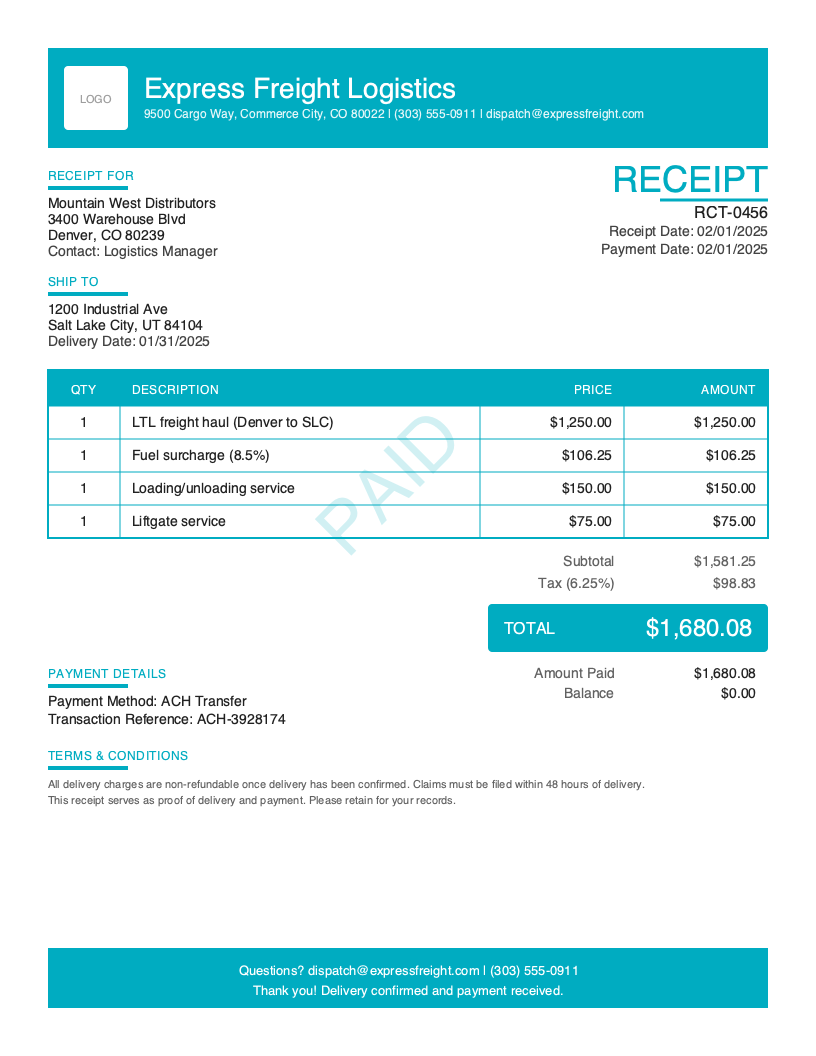
Download Free Delivery Receipt Template

Get Your Free Delivery Receipt Template
Download in your preferred format. Customize with your logo, colors, and business details. Start issuing professional receipts in minutes.
Microsoft Word
Easy to customize, add your logo
Microsoft Excel
Auto-calculate totals and taxes
A signed delivery receipt is the strongest legal protection against 'I never received it' disputes
Time to create and sign a delivery receipt with Pronto Invoice — works offline at any location
Every delivery receipt confirms payment in full with a zero balance and PAID stamp
Your driver just dropped off a $1,581.25 freight shipment at a warehouse in Salt Lake City — LTL haul from Denver, fuel surcharge, loading/unloading, and liftgate service. The receiving manager is standing at the dock with a clipboard. Before your driver pulls away, someone needs to sign confirming the goods arrived, the quantity matches, and the payment is accounted for. That’s a delivery receipt.
Delivery receipts combine two critical functions into one document: proof of delivery and proof of payment. Unlike a basic sales receipt that documents a counter transaction, a delivery receipt tracks physical goods moving from one location to another — with a delivery date, a delivery address, and a recipient signature confirming the items arrived. For businesses that ship, deliver, or transport goods, a signed delivery receipt is the single strongest protection against “I never received it” disputes.
The distinction is precise: a delivery receipt confirms that goods were delivered to a specific location on a specific date, the recipient acknowledged receipt, and payment was collected. It’s not a bill of lading (which covers transport terms), not a packing slip (which lists contents without payment info), and not an invoice (which requests future payment). It’s the closing document that says: the items arrived, someone signed for them, and the money is accounted for.
What you’ll find on this page:
- Free downloadable delivery receipt templates (Word & Excel)
- Complete breakdown of required delivery receipt elements
- When and why delivery receipts protect your business
- Best practices for delivery documentation
- How to create delivery receipts from your phone in under 30 seconds
Download Free Delivery Receipt Templates
Get started immediately with our professionally designed delivery receipt templates. Both formats include a PAID stamp, delivery date field, delivery address, and recipient signature line.
| Format | Best For | Download |
|---|---|---|
| Microsoft Word | Easy customization — add your logo, delivery details, and item descriptions | Download Word |
| Microsoft Excel | Auto-calculate item totals, surcharges, and tax | Download Excel |
Tip: The Excel template includes built-in formulas that calculate line item totals, sum surcharges, and apply tax. Enter quantities and prices — the receipt handles the math. Both templates include a signature block for recipient confirmation.
Both templates include a PAID stamp, delivery date, delivery address, and recipient signature line — the elements that make a delivery receipt legally defensible as both proof of delivery and proof of payment.
Want more polished designs? Create custom receipts with our receipt generator.
What to Include on a Delivery Receipt
A delivery receipt documents a physical handoff: goods left your possession and arrived at the destination. It also confirms that payment was made for those goods and their delivery. Every element should answer two questions: “Did the items arrive?” and “Was the delivery paid for?”
Required Receipt Sections
| Section | What to Include | Why It Matters for Delivery |
|---|---|---|
| Receipt Header | Receipt number (RCT-0001), receipt date, document title “RECEIPT” | Creates a unique record tied to a specific shipment |
| Business Information | Company name, address, phone, email, DOT/MC number if applicable | Identifies the shipper or delivery company; regulatory numbers add credibility |
| Client Information | Client company name, contact person, billing address | Links payment to the ordering party — may differ from the delivery recipient |
| Delivery Address | Full address where goods were delivered | Delivery-specific — the physical location of the handoff; may differ from both billing and business addresses |
| Delivery Date | Date and time goods were delivered | Delivery-specific — establishes when the handoff occurred; critical for claims and warranties |
| Line Items | Items delivered with quantities, descriptions, weights, and prices | Documents exactly what was delivered and what it cost |
| Pricing Summary | Subtotal, surcharges, tax, total, amount paid, balance ($0.00) | Confirms delivery charges were paid in full |
| Payment Details | Payment method used, transaction reference, payment date | Creates a payment trail separate from the delivery confirmation |
| Recipient Signature | Printed name, signature, and date of the person who accepted delivery | Delivery-specific — the most critical element; proves someone at the destination acknowledged receipt of goods |
| PAID Indicator | Prominent PAID stamp or badge | Confirms the financial side of the transaction is settled |
| Terms & Conditions | Damage reporting window, return policy, liability limitations | Protects against claims filed after the acceptance window |
| Thank You Message | Brief gratitude message | Professional close to the delivery transaction |
Critical Delivery Receipt Elements
Recipient Signature This is the defining element of a delivery receipt. A signature from the person at the delivery location — with their printed name, title, and date — creates irrefutable proof that the goods were accepted. Without a signature, a delivery receipt is just a claim that delivery happened. With a signature, it’s a legally binding acknowledgment. For high-value deliveries, consider having the recipient note the condition of the goods alongside their signature.
Delivery Date and Time The exact date (and ideally time) of delivery establishes when responsibility transferred from the shipper to the recipient. This matters for warranty start dates, insurance claims, perishable goods, and time-sensitive contracts. “Delivered January 31, 2025 at 2:45 PM” is far more valuable than “Delivered January 2025.” If goods arrive damaged, the delivery timestamp helps determine whether damage occurred in transit or after acceptance.
Delivery Address The delivery address is often different from the billing address. A distributor in Denver orders goods billed to their headquarters but delivered to a warehouse in Salt Lake City. The delivery receipt must show the actual delivery location — not just the billing address. This confirms where the goods physically ended up and creates a record the recipient can verify against their receiving logs.
Item Verification List every item delivered with quantities, descriptions, and — for freight — weights. The recipient should be able to check the delivery receipt against the physical goods at the loading dock. If 3 pallets were ordered but only 2 arrived, the discrepancy should be noted on the receipt before signing. Some businesses add a “Received in good condition” checkbox or a “Discrepancies” notes field for this purpose.
Understanding Delivery Receipts
When You Need a Delivery Receipt
Delivery receipts apply whenever physical goods change hands at a location:
Freight and logistics. Trucking companies, LTL carriers, and courier services need delivery receipts for every shipment. The signed receipt proves the goods arrived and were accepted — essential for carrier liability and payment collection.
Product deliveries. Furniture stores, appliance retailers, building material suppliers — any business that delivers purchased goods to a customer’s location. The delivery receipt confirms the items arrived in the correct quantity and condition.
Catering and food service. Caterers delivering food for events need the event coordinator to sign confirming the order arrived complete. The delivery receipt also documents payment for the order and delivery fees.
Equipment and rental deliveries. Companies delivering rented equipment (scaffolding, tools, machinery) use delivery receipts to document what was delivered, its condition at delivery, and the charges collected.
Who Uses Delivery Receipts
Delivery receipts serve the small business persona — the 25% of Pronto Invoice users who sell and deliver physical products. Freight operators, distributors, wholesalers, e-commerce businesses with local delivery, catering companies, and any business that moves goods from point A to point B.
The key difference from a service receipt: service receipts document completed labor, delivery receipts document completed physical transfers. A plumber who finishes a repair issues a service receipt. A plumbing supplier who delivers pipe to a job site issues a delivery receipt. Different transaction, different receipt.
Delivery Receipts vs. Other Shipping Documents
A delivery receipt is not a bill of lading (BOL), packing slip, or shipping label. Here’s how they differ:
- Bill of lading: A legal contract between shipper and carrier governing transport. It doesn’t confirm delivery or payment.
- Packing slip: Lists contents of a package. No pricing, no payment information, no signature.
- Delivery receipt: Confirms delivery happened, items were accepted, and payment was made. It’s the closing document.
Some businesses combine elements — a delivery receipt that also serves as a signed packing list. But the receipt function (payment confirmation + PAID stamp) is what distinguishes it.
Legal and Insurance Implications
A signed delivery receipt is primary evidence in shipping disputes. If a customer claims goods never arrived, the signed receipt proves otherwise. If goods arrived damaged, the receipt documents whether damage was noted at the time of acceptance. Insurance companies require delivery documentation to process claims — the delivery receipt, including recipient signature and item condition notes, is the foundation of any freight claim.
Create Delivery Receipts in Under 30 Seconds
Paper receipt books tear in the rain. Spreadsheets require a laptop at the loading dock. When your driver is at a delivery site with ten minutes before the next stop, you need a receipt that can be created and signed on a phone.
Pronto Invoice is built for businesses that deliver goods in the field. Create signed delivery receipts from a phone or tablet in 5 simple steps.
- Select Client — choose from saved clients or add the receiving company on the spot
- Add Items — pick from saved products or enter the delivered items with quantities, weights, and prices
- Payment Info — select the payment method used (ACH, check, card) and enter the transaction reference
- Document Details — receipt number auto-generates; add delivery date, delivery address, and notes
- Review & Sign — the recipient signs on-screen, confirming delivery and creating a permanent record
The key difference from invoicing: Step 3 asks “How was this paid?” — not “How can they pay?” And Step 5 includes the recipient’s signature — unique to delivery receipts.
Features for Professional Delivery Receipts
- PAID Stamp — every receipt includes a prominent PAID indicator, automatically applied
- On-Screen Signature — the recipient signs directly on your phone or tablet. Stored permanently with the receipt.
- Offline Capability — create and sign delivery receipts at warehouses, construction sites, and rural locations with no signal. Syncs when connected.
- Photo Attachments — photograph the delivered goods, loading dock condition, or any damage. Attach up to 4 photos to the receipt.
- Delivery Date Tracking — record the exact delivery date and time for warranty and claim documentation
- Multiple Payment Methods — track ACH, check, credit card, and other payment methods common in delivery and logistics
- Auto-Receipt on Payment — if the delivery was invoiced first, record payment and the receipt auto-generates
- Invoice-to-Receipt — convert any paid delivery invoice to a signed receipt with one tap
Create Your First Delivery Receipt Free →
Related Receipt Templates
Looking for other receipt types? Browse our complete collection:
- Sales Receipt Template — general-purpose receipt for any transaction
- Cash Receipt Template — cash payment documentation with signature
- Service Receipt Template — labor and maintenance work
- Contractor Receipt Template — construction project receipts
- All Receipt Templates
- Transportation Invoice Template
- Catering Invoice Template
- All Invoice Templates
Start Creating Professional Delivery Receipts Today
Every delivery deserves a signed receipt — for your protection, your client’s records, and your insurance documentation. Pronto Invoice creates delivery receipts with on-screen signature capture in under 30 seconds, works offline at any delivery location, and stores every signed receipt permanently in the cloud.
Create Free Delivery Receipt → | Download the App →
This guide is for informational purposes only and does not constitute legal or tax advice. Consult with a qualified professional for guidance specific to your situation and jurisdiction.
Last updated: March 2026
Delivery Receipt Best Practices
Get the Signature Before Your Driver Leaves
Never leave the delivery location without a signed receipt. Once the truck pulls away, getting a signature after the fact is nearly impossible. A mobile receipt app with on-screen signature capture makes this a 15-second process.
Document Item Condition at Delivery
Go beyond quantity verification. Note the condition of goods at delivery: '3 pallets received in good condition' or '1 carton with visible damage — noted before acceptance.' This protects you if the recipient later claims items were damaged during shipping.
Use a Professional, Branded Document
A professional delivery receipt communicates reliability. When the receiving manager sees a clean, branded document with organized line items and clear delivery details, it reinforces confidence in your operation.
Include All Delivery Charges as Separate Line Items
Don't bury delivery costs in the product price. List them separately: freight haul, fuel surcharge, loading/unloading, liftgate service. Transparent delivery charges prevent disputes and help clients allocate costs correctly.
Record the Delivery Date and Time
Timestamp every delivery. The date and time establish when responsibility transferred and when warranty or return windows begin. For perishable goods or time-sensitive deliveries, the timestamp is essential.
Keep Copies of Every Signed Receipt
A delivery receipt without a backup can disappear. Digital receipts are ideal — the signature is captured on-screen, stored in the cloud, and searchable by client, date, or receipt number. Carrier liability claims can surface months later.
Match Receipt Items to the Purchase Order
The items on your delivery receipt should match the client's purchase order exactly — same descriptions, same quantities, same item numbers. This makes the receiving process smooth and prevents rejections.
Frequently Asked Questions
A professional delivery receipt should include: your business name and contact information, the client's billing information, a unique receipt number (RCT-0001 format), the delivery date and time, the delivery address, an itemized list of goods delivered with quantities and prices, subtotal, surcharges, tax, total, amount paid, payment method and transaction reference, a PAID stamp, a recipient signature with printed name and date, and any condition notes.
No. An invoice requests payment before or after delivery — it's a bill. A delivery receipt confirms that goods were delivered and payment was received. It's the closing document. If you ship goods and invoice for payment later, the delivery receipt is generated when that invoice is paid. If payment is collected at delivery, the delivery receipt documents both the handoff and the payment simultaneously.
No. A bill of lading (BOL) is a legal contract between the shipper and carrier that governs transport terms, liability, and freight classification. A delivery receipt confirms that delivery was completed, goods were accepted, and payment was made. The BOL covers the journey; the delivery receipt covers the arrival and payment. Both documents may be needed for a complete shipping record.
Strongly recommended. A recipient signature is the strongest proof that goods were delivered and accepted. Without it, you're relying on GPS timestamps or driver testimony — both weaker than a signed document. For high-value shipments, a signature is essential for insurance claims and dispute resolution.
Use a mobile invoicing app like Pronto Invoice. Tap 'New Receipt,' select the delivery receipt type, add the client and delivery address, enter the delivered items, set the payment method, add the delivery date, and have the recipient sign on your phone screen. The entire process takes under 30 seconds and works offline at any delivery location.
If the recipient notices damage at delivery, note it on the receipt before they sign: '1 carton received with visible damage to exterior packaging.' The recipient can add their own notes or refuse the damaged items. This documentation is critical for filing freight claims and resolving disputes. If using a mobile app, photograph the damage and attach the photos to the receipt.
Keep delivery receipts for at least three years for tax purposes. For goods with warranties, keep the receipt for the warranty duration plus one year. For freight and logistics businesses, retain delivery receipts for at least five years — carrier liability claims can surface long after delivery. Digital storage ensures receipts remain accessible and searchable.
Related Receipt Templates
Start Creating Professional Receipts Today
Create your first receipt in under 30 seconds. Join thousands of professionals who use Pronto Invoice to issue receipts on the spot.
This guide is for informational purposes only and does not constitute legal or tax advice.