
Free Donation Receipt Template
Create IRS-compliant donation receipts in under 30 seconds. Download free templates with EIN, tax-deductible language, donor details, and PAID confirmation.
Download Free Donation Receipt Template
Get Your Free Donation Receipt Template
Download in your preferred format. Customize with your logo, colors, and business details. Start issuing professional receipts in minutes.
Microsoft Word
Easy to customize, add your logo
Microsoft Excel
Auto-calculate totals and taxes
The IRS requires written acknowledgment for any single charitable contribution of $250 or more
Minimum time nonprofits should maintain donation receipt records for IRS audit compliance
Recommended maximum time to issue a donation receipt after receiving a gift
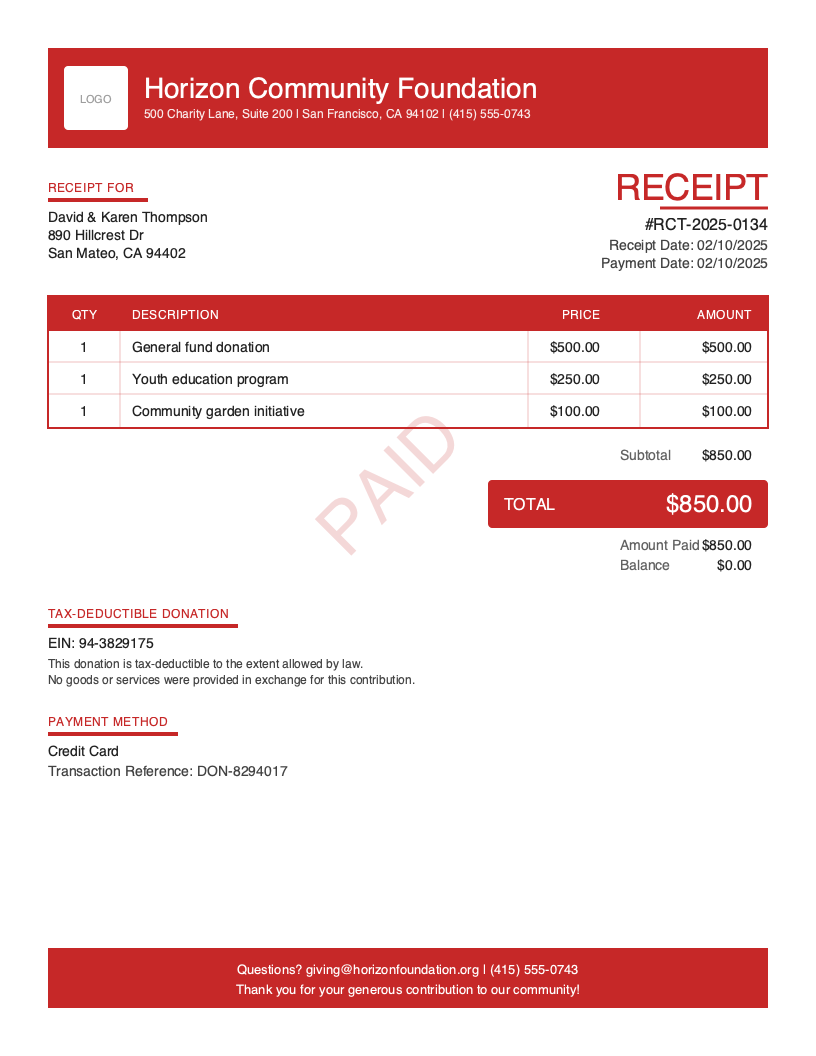
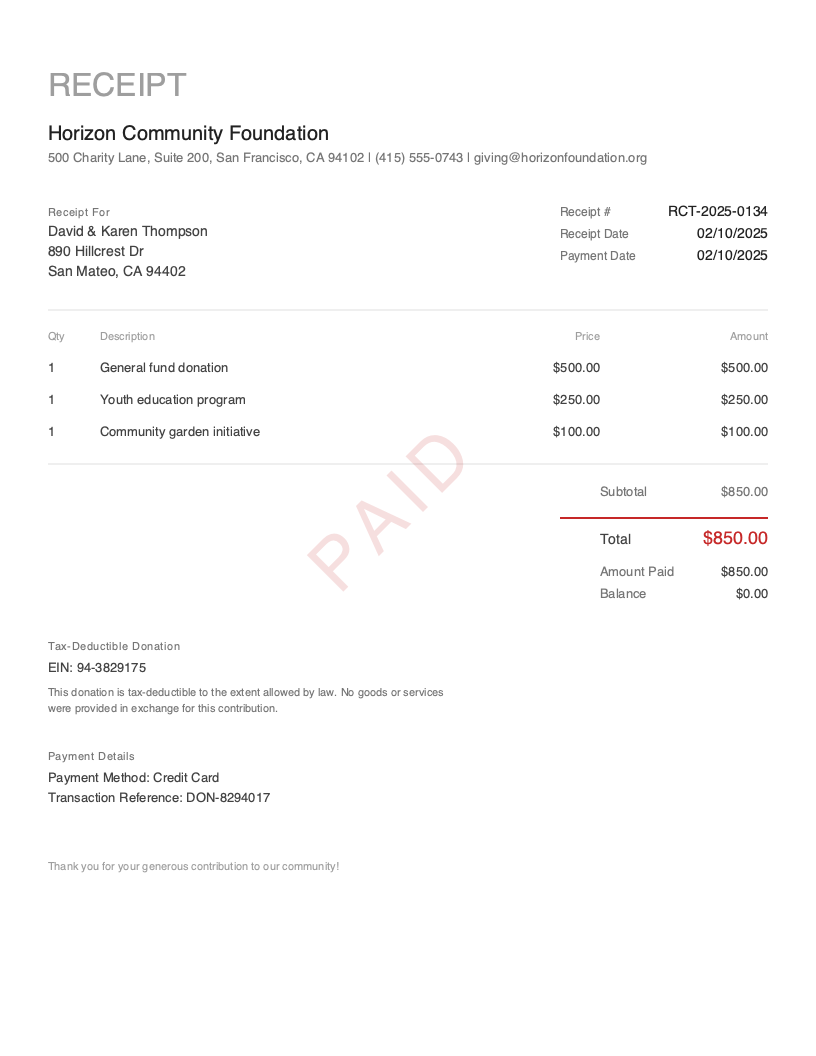
A couple donates $850 to your community foundation — $500 to the general fund, $250 to the youth education program, and $100 to the community garden initiative. They pay by credit card. Now they need a document for their tax return — not a thank-you email, not a pledge form, but a formal donation receipt with your organization’s EIN, the exact amount, the date, and a written statement that no goods or services were provided in exchange for the contribution. Without that statement, the IRS may disallow their deduction entirely.
Donation receipts are the most legally prescribed receipt type. The IRS requires written acknowledgment for any single charitable contribution of $250 or more — and the acknowledgment must include specific language about whether goods or services were provided in exchange. Get the language wrong, omit the EIN, or fail to send the receipt before the donor files their return, and you’ve cost your supporter a tax deduction. For nonprofits, donation receipts aren’t just professional courtesy — they’re a legal obligation that directly affects donor trust and future giving.
Here’s what separates a donation receipt from every other receipt type: it exists primarily for tax compliance, not just proof of payment. A sales receipt confirms a purchase. A cash receipt confirms cash changed hands. A donation receipt confirms a charitable contribution and provides the IRS-required documentation for the donor to claim a tax deduction. Every donation receipt must include the organization’s EIN, the contribution amount, the date, and the goods-or-services disclosure statement.
What you’ll find on this page:
- Free downloadable donation receipt templates (Word & Excel)
- Complete breakdown of IRS-required receipt elements
- When and why nonprofits must issue donation receipts
- Best practices for IRS-compliant donation acknowledgments
- How to create donation receipts efficiently
Download Free Donation Receipt Templates
Get started immediately with our professionally designed donation receipt templates. Both formats include IRS-required fields: organization EIN, donor information, contribution details, goods-or-services disclosure, and tax-deductible language.
| Format | Best For | Download |
|---|---|---|
| Microsoft Word | Easy customization — add your nonprofit name, logo, EIN, and mission statement | Download Word |
| Microsoft Excel | Auto-calculate multiple gift line items and annual totals | Download Excel |
Tip: The Excel template includes built-in formulas that total multiple contribution line items (general fund, specific programs, campaigns) into a single receipt amount. Enter each gift designation — the receipt calculates the total automatically.
Both templates include IRS-compliant language, EIN field, goods-or-services disclosure, donor information, and a PAID confirmation — the elements required for your donors to claim their tax deductions.
Want more polished designs? Create custom receipts with our receipt generator.
What to Include on a Donation Receipt
A donation receipt serves one primary purpose: providing the donor with IRS-compliant documentation to substantiate a charitable contribution deduction. Unlike a business receipt that simply confirms a transaction, a donation receipt must contain specific legal language prescribed by the Internal Revenue Service. Missing a required element doesn’t just look unprofessional — it can invalidate the donor’s deduction.
Required Receipt Sections
| Section | What to Include | Why It Matters for Donations |
|---|---|---|
| Receipt Header | Receipt number (RCT-2025-0134), receipt date, document title “DONATION RECEIPT” | Creates a traceable record; the date is critical for the donor’s tax year |
| Organization Information | Nonprofit name, address, phone, email | Identifies the qualified charitable organization receiving the gift |
| Donor Information | Donor name and mailing address | Must match the name on the donor’s tax return; required for IRS substantiation |
| EIN / Tax ID | Organization’s Employer Identification Number | Donation-specific — proves the organization is a qualified 501(c)(3); donors and the IRS use this to verify eligibility |
| Line Items | Contribution designations with amounts (general fund, specific programs) | Shows how the donation was allocated; useful for restricted gift tracking |
| Pricing Summary | Total contribution amount | Confirms the exact dollar amount for the donor’s tax filing |
| Tax-Deductible Statement | IRS-required goods-or-services disclosure | Donation-specific — legally required language stating whether anything was given in exchange for the contribution |
| Payment Details | Payment method (credit card, check, cash), transaction reference, donation date | Documents how and when the gift was made; the date determines the tax year |
| PAID Indicator | Confirmation stamp or badge | Confirms the contribution was received — not pledged, not pending |
| Thank You Message | Gratitude and impact statement | Strengthens donor relationship; mention how the gift will be used |
Critical Donation Receipt Elements
Employer Identification Number (EIN) The EIN is the single most important field on a donation receipt. It’s the nine-digit number assigned to your nonprofit by the IRS (format: XX-XXXXXXX). Donors and their tax preparers use this number to verify that your organization is a qualified 501(c)(3) eligible to receive tax-deductible contributions. Without the EIN on the receipt, the donor’s accountant may reject it, and the IRS can disallow the deduction during an audit. Display it prominently — not buried in fine print.
Goods-or-Services Disclosure Statement The IRS requires every donation receipt for contributions of $250 or more to include a statement about whether the organization provided any goods or services in exchange for the contribution. For a pure cash donation with nothing given in return, the language reads: “No goods or services were provided in exchange for this contribution.” For gala dinners, benefit concerts, or auction events where the donor received something of value, the receipt must state the value of what was provided and subtract it from the contribution amount. This is the element most nonprofits get wrong — and the one the IRS looks for during audits.
Contribution Date The date of the donation determines which tax year the deduction applies to. A check mailed on December 31 counts for that tax year even if the nonprofit deposits it in January. A credit card charge on December 31 counts for that year based on the transaction date, not the settlement date. Get the date right on the receipt — an incorrect date can shift a deduction to the wrong tax year and create problems for the donor during filing.
Donor Legal Name and Address The donor name on the receipt must match the name on the donor’s tax return. For individual donors, use their full legal name — not a nickname, not a business name unless the gift came from a business entity. For married couples filing jointly, include both names if both are donors of record. The mailing address confirms the donor’s identity and is used by the IRS for matching during audits.
Understanding Donation Receipts
When You Need a Donation Receipt
The IRS has specific thresholds and rules for donation receipts:
Any single contribution of $250 or more. The IRS requires a written acknowledgment (donation receipt) for any single contribution of $250 or more. The donor cannot claim the deduction using only a bank statement or cancelled check — they must have a receipt from the organization. This is a hard requirement, not a best practice.
Contributions under $250. While not legally required by the IRS for amounts under $250 (the donor can use their own bank records), providing receipts for all contributions is standard nonprofit practice. Many donors expect receipts regardless of amount, and consistent receipt issuance builds trust and professionalism.
Non-cash donations (in-kind gifts). When donors contribute property, goods, or services instead of cash, the receipt must describe the items donated but should not assign a dollar value — the donor is responsible for determining fair market value. For non-cash gifts over $500, donors must file IRS Form 8283. For gifts over $5,000, an independent appraisal is required.
Quid pro quo contributions over $75. When a donor makes a payment exceeding $75 and receives something of value in return (gala dinner, benefit tickets, auction items), the organization must provide a written disclosure stating the estimated fair market value of what was provided. The tax-deductible amount is the contribution minus the fair market value of the benefit received.
Year-end annual summaries. Many nonprofits send year-end summary receipts listing all contributions for the calendar year. While the IRS doesn’t require annual summaries specifically, donors find them invaluable for tax preparation. The summary should list each gift with its date, amount, and designation, plus a cumulative total.
Who Uses Donation Receipts
Donation receipts serve a content-only audience for Pronto Invoice — primarily nonprofit organizations, churches, community foundations, and charitable entities. Small nonprofits without dedicated donor management software are the largest segment. They rely on templates, spreadsheets, or manual processes to acknowledge contributions. Larger nonprofits with CRM platforms like Bloomerang, DonorPerfect, or Salesforce Nonprofit generate receipts automatically, but smaller organizations need standalone tools.
The donor is the ultimate user of the receipt — they file it with their tax return and may need it years later if audited.
Donation Receipts vs. Invoices
Nonprofits don’t invoice donors. An invoice requests payment for goods or services rendered — that’s a commercial transaction. A donation is a voluntary gift with no obligation. The donation receipt acknowledges the gift after it’s made. Some nonprofits send pledge reminders (similar in function to an invoice), but the donation receipt is fundamentally different: it confirms a completed charitable contribution, not a commercial obligation.
Tax Implications for Donors and Organizations
For donors, the donation receipt is their substantiation for the charitable contribution deduction on Schedule A (itemized deductions) of their federal tax return. Without a valid receipt for contributions of $250 or more, the deduction is disallowed — even if the donor has bank statements or cancelled checks.
For organizations, issuing accurate donation receipts is a compliance obligation that maintains 501(c)(3) status. The IRS can revoke tax-exempt status from organizations that fail to provide proper acknowledgments or that misstate the tax-deductible amount of contributions. Donor trust is also at stake: if a donor’s deduction is disallowed because your receipt was incomplete, they’re unlikely to give again.
Creating Donation Receipts Efficiently
Downloadable templates work well for smaller nonprofits processing donations manually. Fill in the donor name, contribution details, date, EIN, and goods-or-services statement — print or email the receipt. Our Word and Excel templates at the top of this page include all IRS-required fields and are ready to use immediately.
For nonprofits that also operate business activities — consulting services, event management, merchandise sales — and need invoicing alongside donation receipts, Pronto Invoice handles business invoicing, payment tracking, and receipt generation for the commercial side of your operations. While donation-specific features aren’t part of our core product, organizations with dual revenue streams (charitable contributions and earned income) use Pronto Invoice for business transactions.
Try Pronto Invoice for business invoicing →
Related Receipt Templates
Looking for other receipt types? Browse our complete collection:
- Cash Receipt Template — cash payment documentation with signature field
- Sales Receipt Template — product and service purchase receipts
- Payment Receipt Template — general payment confirmations
- Rent Receipt Template — rental payment documentation for landlords
- All Receipt Templates
- All Invoice Templates
Start Issuing Professional Donation Receipts Today
Your donors deserve IRS-compliant documentation that protects their tax deductions and reflects your organization’s professionalism. Download our free donation receipt templates above to start issuing polished acknowledgments with your EIN, goods-or-services disclosure, contribution details, and PAID confirmation immediately.
Download Free Donation Receipt Template → | Browse All Receipt Templates →
This guide is for informational purposes only and does not constitute legal or tax advice. Consult with a qualified professional for guidance specific to your situation and jurisdiction.
Last updated: March 2026
Donation Receipt Best Practices
Send Receipts Within 48 Hours of Receiving a Gift
Prompt acknowledgment confirms the transaction for the donor's records and demonstrates organizational competence. For online donations, set up automated receipt emails that trigger immediately. For checks, batch-process receipts weekly at minimum.
Include the Goods-or-Services Statement on Every Receipt
Even for pure cash donations, include the explicit statement: 'No goods or services were provided in exchange for this contribution.' The IRS looks for this language specifically. For event-based contributions, calculate and state the fair market value of what was provided.
Present a Polished, Trustworthy Document
Your donation receipt represents your organization's credibility. A clean, branded receipt with your logo, EIN displayed prominently, and clear IRS-compliant language tells donors their money is being managed professionally.
Display Your EIN Prominently
Don't bury the Employer Identification Number in the footer. Place it near your organization name in the header or in a dedicated field that's immediately visible. Tax preparers look for the EIN first.
Separate Designations as Individual Line Items
When a donor contributes to multiple funds or programs, list each designation as a separate line item. This serves donor intent documentation, simplifies fund accounting, and gives the donor a clear view of how their contribution was allocated.
Issue Year-End Summary Receipts
In January, send every donor a summary receipt listing all their contributions for the prior calendar year. Include each gift date, amount, designation, payment method, cumulative total, and your EIN.
Maintain Receipt Records for at Least Seven Years
The IRS can audit returns up to three years after filing (six years for substantial understatement). Keep digital copies of every donation receipt organized by year and donor name for quick retrieval.
Frequently Asked Questions
An IRS-compliant donation receipt should include: your organization's legal name and address; EIN (Employer Identification Number); the donor's full legal name and mailing address; the date of the contribution; the total contribution amount; a description of any non-cash items donated (without a dollar value); a statement of whether goods or services were provided in exchange (and their estimated fair market value if so); and a PAID confirmation that the donation was received.
No — and this distinction is especially important for nonprofits. An invoice is a commercial document requesting payment for goods or services. A donation receipt acknowledges a voluntary charitable gift that has already been made. Nonprofits don't invoice donors (though they may send pledge reminders). The donation receipt confirms the contribution was received, provides IRS-required documentation, and enables the donor to claim a tax deduction.
The IRS requires a written acknowledgment for any single contribution of $250 or more. For contributions under $250, the donor can rely on their own bank records. However, best practice is to issue receipts for all contributions regardless of amount — donors expect them, they build trust, and they simplify year-end reporting for both parties.
The IRS requires every donation receipt for contributions of $250 or more to include a written statement about whether the organization provided goods or services in exchange for the contribution. For pure donations: 'No goods or services were provided in exchange for this contribution.' For benefit events: 'The estimated fair market value of goods/services provided is $[amount].' Without this statement, the donor's deduction can be disallowed during an IRS audit.
For donated goods, property, or services, describe the items on the receipt but do not assign a dollar value — the donor is responsible for determining fair market value. For non-cash gifts over $500, the donor must file IRS Form 8283 with their return. For gifts over $5,000 (excluding publicly traded securities), an independent appraisal is required.
Download our free Word or Excel template at the top of this page and fill it in from any device. For recurring or high-volume donation acknowledgments, consider donor management software that automates receipt generation. The key requirement: include your EIN, the donor's legal name, the contribution date and amount, and the goods-or-services disclosure statement.
Send annual summary receipts in early to mid-January — before donors begin tax preparation. The summary should list every contribution for the prior calendar year with the date, amount, designation, and payment method for each gift, plus a cumulative total, your EIN, and the goods-or-services statement.
Related Receipt Templates
Start Creating Professional Receipts Today
Create your first receipt in under 30 seconds. Join thousands of professionals who use Pronto Invoice to issue receipts on the spot.
This guide is for informational purposes only and does not constitute legal or tax advice.